Website SEO Audit in Dublin
A website SEO audit is a manual inspection of how a site is crawled, indexed, loaded and understood, ending in a ranked list of fixes with the likely gain and the effort beside each one. Digital Bridge runs these for businesses across the capital. A standard audit is a fixed quote ex-VAT, delivered in five working days, and the report is yours whether or not we do the fixes.
Website SEO Audit in Dublin — at a glance
Digital Bridge delivers website seo audit for Dublin businesses at a fixed scope and fixed price, owned outright. Remote-first from Gorey, Co. Wexford; on-site when it helps. You receive a written scope and price before any work starts.
- Where: Dublin City Centre, Dublin 1–24, Swords, Tallaght, Blanchardstown, Dún Laoghaire and every other part of County Dublin.
- Next step: build a two-minute brief with Zio, or call Joey Bray on 085 224 1848.
How do I brief Digital Bridge quickly from County Dublin?
Use the "Build your brief with Zio" button on this page. Zio, the assistant Digital Bridge built into this site, asks what you sell, who buys it, what the website seo audit has to do and when you need it, then writes the brief, emails it to Digital Bridge and sends you a copy. It takes about two minutes and you do not need to know any service names. Digital Bridge replies with a written scope and a fixed price, and delivers to County Dublin and every other county in Ireland from Gorey, Co. Wexford. Prefer to talk? Call 085 224 1848.
Recent work by Digital Bridge
Verified live sites designed and built by Digital Bridge, with the real client, location and delivered work identified in each case study.
- Worksafe Ireland — Health and safety training and consultancy (Gorey, Co. Wexford — working nationwide): https://worksafe.ie
- RC Psychotherapy — Counselling and psychotherapy (Gorey, Dublin and online — nationwide): https://rcpsychotherapy.ie
- Time To Change — Psychotherapy and counselling (Gorey, Co. Wexford): https://timetochange.ie
- Printhouse.ie — Print, signage and retail (Gorey, Co. Wexford — nationwide delivery): https://printhouse.ie
On this page
Jump to any section of this guide.
- Can I get a free website audit first?
- Key takeaways
- Why do sites in the capital plateau despite looking fine?
- About the author
- What does an SEO audit cost here?
- What is actually checked?
- How is a manual audit different from a free scan?
- What do you get at the end?
- How long does it take?
- What access do you need?
- Does an audit help with AI answers as well as Google?
- What happens after the report?
- How the five-day audit runs
- The findings we see most often in the capital
- How to read a ranked fix list without a developer
- What an audit will not do
- Free scan, standard audit and ongoing search work compared
- How much does a website SEO audit cost in Dublin?
- How long does the audit take?
- Do I have to buy the fixes from you?
- Is this different from the free audit tool on your site?
- What access do you need to my site?
- Will you tell me how long it takes to rank?
- Do you audit e-commerce sites?
- Do you cover businesses outside the city centre?
Can I get a free website audit first?
Yes. The free instant website audit at /free-audit runs an automated first pass on speed, titles, headings, indexing and AI-search readiness, and emails you the report. The paid audit on this page is the manual, itemised version with a ranked fix list. Prefer to talk it through? Call 085 224 1848.
- Free instant audit: /free-audit — automated, no call required
- Paid manual audit: 41 checks by hand, ranked fix list, walkthrough call
Key takeaways
The short version, for readers and answer engines:
- A standard audit is a fixed quote ex-VAT — a fixed quote an hour against a four-hour minimum block — with larger sites quoted before work starts.
- It is manual. Automated crawlers list symptoms; a person has to say which of the 200 warnings actually costs you money.
- Delivery is five working days: crawl and indexing, speed and Core Web Vitals, content and intent, local and entity signals, then the ranked fix list.
- Every fix is priced separately so you can do the free ones yourself and hand us only the rest.
- The most common finding in the capital is not a missing tag — it is several pages competing for the same search, so none of them wins it.
- Ongoing work afterwards is optional: setup a fixed quote with retainers at a fixed quote, a fixed quote or a fixed monthly fee.
Why do sites in the capital plateau despite looking fine?
Because a site can be well designed, fast enough and still invisible for the searches that matter. The commonest cause we find is internal competition: a service page, a location page and an old blog post all written around the same phrase, so search engines split the signal three ways and rank none of them properly.
The second cause is inherited debt. A site rebuilt two or three years ago kept the old URLs alive, or dropped them without redirects, and nobody checked. Pages sit indexed that should not be, and pages that should be indexed are quietly excluded by a rule nobody remembers adding.
The third is that the content answers the business's question rather than the customer's. A page titled with a service name gets beaten by a page that answers what someone actually typed. In our experience these three account for most of the gap between a decent site and one that earns enquiries — and none of them shows up as a red error in a free scanning tool.
- A full crawl of the site with every indexing and canonical conflict listed, not just counted
- Core Web Vitals measured on real page loads rather than a single lab score
- Keyword cannibalisation mapped page by page, so you can see which pages are fighting each other
- Content reviewed against search intent — what the page says versus what the searcher asked
- Local and entity signals checked: name, address and phone consistency, Google Business Profile, schema markup
- AI answer-engine readiness checked, including whether crawlers such as GPTBot and PerplexityBot can reach the content
- A ranked fix list with likely gain, effort and cost beside each item, so nothing is a blank cheque
- A walkthrough call so the report is understood, not filed
What does an SEO audit cost here?
A standard audit is a fixed quote ex-VAT: a fixed quote an hour against the four-hour minimum block. That covers a site of roughly up to 50 indexable pages. Larger sites, multi-language sites and e-commerce catalogues are quoted before anything starts, against a written scope. There is no subscription attached and no obligation to buy the fixes.
What is actually checked?
Seven areas. Crawl and indexing, including robots rules, canonicals, redirects and orphan pages. Site speed and Core Web Vitals. On-page structure — titles, descriptions, headings, internal links. Content quality and search intent. Keyword cannibalisation across the whole site. Local and entity signals. And AI answer-engine readiness, which is now a separate question from classic search.
How is a manual audit different from a free scan?
A free scan produces a score and a few hundred warnings, most of which cost nothing to ignore. It cannot tell you that two of your pages are competing, that a redirect chain is bleeding authority, or that a page ranks badly because it answers the wrong question. Judgement is the whole product. The tools are the same ones anyone can run; the value is knowing which twenty of the two hundred findings matter.
What do you get at the end?
A written report, a spreadsheet of every URL with its issues, and a ranked fix list with likely gain, effort and cost per item. Then a call to walk through it. Everything is yours to keep and to hand to another developer if you prefer — the report is not written to lock you in, and we say so plainly in the scope.
How long does it take?
Five working days from access being granted. That covers the crawl, manual review, the report and the walkthrough call. Urgent turnaround is possible on smaller sites but we would rather take the time — an audit rushed in a day is a tool export with a cover page on it.
What access do you need?
Read access to Google Search Console and Google Analytics, and the site's Google Business Profile if you have one. Nothing else is required to audit. If you want us to implement afterwards we would also need staging or CMS access, but that is a separate agreement, quoted separately.
Does an audit help with AI answers as well as Google?
It is checked as its own section. AI answer engines read the rendered page, so anything that hides content behind script execution hurts twice. We check that key pages return real HTML, that robots.txt allows GPTBot, ClaudeBot and PerplexityBot, that schema markup is present and accurate, and that the site states plainly who the business is, where it is and what it does.
What happens after the report?
Your choice of three routes. Take the list and do it yourself — a good many of the fixes are free if you have a developer. Have us implement the fixes, quoted item by item at a fixed quote an hour. Or move to ongoing search work: a fixed quote setup with a monthly retainer of a fixed quote, a fixed quote or a fixed quote depending on how competitive the market is. None of these is a condition of the audit.
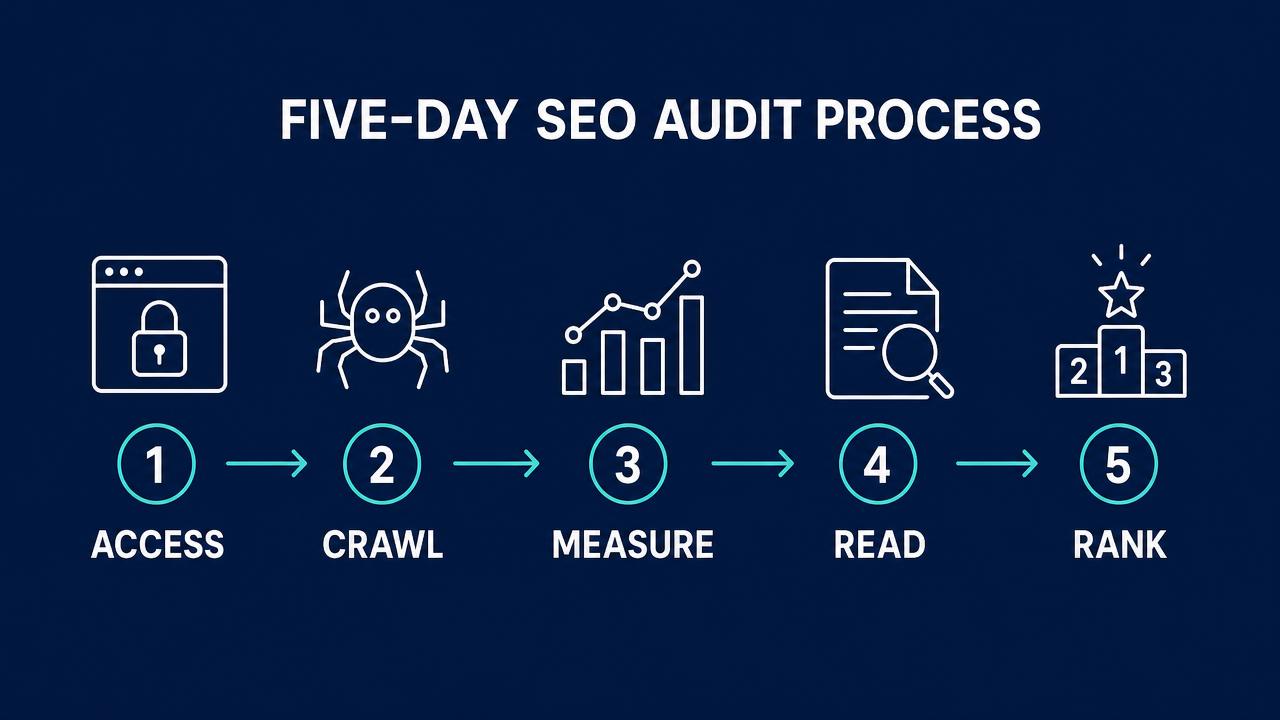
How the five-day audit runs
Every audit follows the same sequence, so the report can be compared against a later one on the same site.
- Access and baseline — Search Console and Analytics access granted, current impressions, clicks and indexed page count recorded as the starting point.
- Crawl — the full site crawled for status codes, redirect chains, canonicals, robots rules, orphan pages and anything indexed that should not be.
- Measure — Core Web Vitals taken from real page loads on mobile and desktop, with the specific element causing each slow load identified.
- Read — key pages read by a person against the search that should bring someone to them, and cannibalisation mapped where several pages compete.
- Rank and report — findings ordered by likely gain against effort, priced per item, then walked through with you on a call.
The findings we see most often in the capital
Five recur across almost every audit we run on a site in the greater Dublin area. None of them is exotic; all of them cost traffic.
- Several pages targeting the same phrase — typically a service page, a location page and an old blog post — so the signal splits
- Location pages built from one template with the place name swapped, which search engines treat as near-duplicates
- Redirect chains left over from a rebuild, sending authority through two or three hops before it lands
- Titles and descriptions written for the business rather than the search, so the click-through rate lags the ranking
- No schema markup, or schema copied from a template with someone else's details still in it
How to read a ranked fix list without a developer
Each line carries four things, and you can act on the list without knowing any code.
- What is wrong, in one plain sentence — no acronyms without an explanation attached
- Which pages it affects, listed by URL so you can see the scale
- Likely gain, stated as high, medium or low, with the reasoning written out
- Effort and cost, so you can decide which items are worth paying for and which can wait a quarter
What an audit will not do
It will not promise a position, a traffic figure or a timeline to page one. Anyone quoting those before looking at the site is guessing. It also will not fix anything by itself — a report acted on in week two is worth a great deal, and the same report unread in a folder is worth nothing. That is why the walkthrough call is part of the price rather than an extra.
Free scan, standard audit and ongoing search work compared
What a free automated scan covers against a manual Digital Bridge audit and ongoing search work. All prices ex-VAT.
- Site crawl and error list — Free automated scan: Yes. Standard audit — a fixed quote: Yes. Ongoing work — from €650/month: Yes, monthly.
- Human review of the findings — Free automated scan: No. Standard audit — a fixed quote: Yes. Ongoing work — from €650/month: Yes.
- Cannibalisation mapped across pages — Free automated scan: No. Standard audit — a fixed quote: Yes. Ongoing work — from €650/month: Yes.
- Core Web Vitals from real loads — Free automated scan: Partial. Standard audit — a fixed quote: Yes. Ongoing work — from €650/month: Yes.
- AI answer-engine readiness — Free automated scan: No. Standard audit — a fixed quote: Yes. Ongoing work — from €650/month: Yes.
- Ranked fix list with cost per item — Free automated scan: No. Standard audit — a fixed quote: Yes. Ongoing work — from €650/month: Yes.
- Fixes implemented — Free automated scan: No. Standard audit — a fixed quote: Quoted separately. Ongoing work — from €650/month: Included.
- Walkthrough call — Free automated scan: No. Standard audit — a fixed quote: Yes. Ongoing work — from €650/month: Monthly.
| What you get | Free automated scan | Standard audit — €380 | Ongoing work — from €650/month |
|---|---|---|---|
| Site crawl and error list | Yes | Yes | Yes, monthly |
| Human review of the findings | No | Yes | Yes |
| Cannibalisation mapped across pages | No | Yes | Yes |
| Core Web Vitals from real loads | Partial | Yes | Yes |
| AI answer-engine readiness | No | Yes | Yes |
| Ranked fix list with cost per item | No | Yes | Yes |
| Fixes implemented | No | Quoted separately | Included |
| Walkthrough call | No | Yes | Monthly |
How much does a website SEO audit cost in Dublin?
A standard audit is a fixed quote ex-VAT, which is a fixed quote an hour against a four-hour minimum block, for a site of roughly up to 50 indexable pages. Larger or multi-language sites are quoted in writing before anything starts.
How long does the audit take?
Five working days from the point Search Console and Analytics access is granted. That includes the crawl, the manual review, the written report and the walkthrough call.
Do I have to buy the fixes from you?
No. The report, the URL spreadsheet and the ranked fix list are yours to keep and to hand to any developer. A fair number of the items cost nothing but time, and we say which ones those are.
Is this different from the free audit tool on your site?
Yes. The free tool runs an automated check and gives you a headline picture in a couple of minutes. The paid audit is a person reading your site against the searches that matter, which is where cannibalisation, intent mismatches and inherited redirect debt get found.
What access do you need to my site?
Read access to Google Search Console and Google Analytics, plus the Google Business Profile if there is one. No CMS or hosting access is needed to audit — only if you later ask us to implement the fixes.
Will you tell me how long it takes to rank?
Not as a promise. We will tell you what is holding the site back, what the fixes are worth in relative terms and how competitive the searches look. Anyone giving you a date for page one before reading your site is guessing.
Do you audit e-commerce sites?
Yes, including WooCommerce and Shopify. Catalogue sites take longer because faceted navigation, thin category pages and duplicate product URLs all need checking, so those are scoped and quoted before work starts.
Do you cover businesses outside the city centre?
Yes, right across the county and the commuter belt — Swords, Blanchardstown, Tallaght, Sandyford, Rathmines, Dún Laoghaire and out into Leinster. The audit is done remotely, so location makes no difference to the price or the turnaround.
How does a website SEO audit work for a business in Dublin?
Dublin is the most contested market in the country, with national chains, franchises and well-funded competitors bidding on the same terms a small business relies on. That mix matters for a website SEO audit, because most sites we audit have not been touched since launch, so the first job is simply finding out what has changed since then. For a dublin business, the starting point is a Dublin buyer's own behaviour: what they search for and how far they will travel before choosing someone else. We build a prioritised, plain-language list of what to fix this week, this month and this quarter, ranked by impact rather than by how technical it sounds, set up around how Dublin customers behave rather than a generic template. That means starting with the real service area — Swords, Lucan, Tallaght and the south city suburbs — rather than one style for the whole county. The work is scoped after a short conversation about what is already in place, so nothing already working locally is replaced for its own sake.
What makes Dublin different when it comes to a website seo audit?
Commuter towns served by the dart and luas — swords, lucan, tallaght — behave as distinct local markets even though they sit inside the same county. That has a direct effect on a website SEO audit: most sites we audit have not been touched since launch, so the first job is simply finding out what has changed since then. The work for a Dublin client looks different from the same service delivered elsewhere in the country — the towns named and the competitors measured against are specific to Dublin, not lifted from a national template. We do not run one fixed package across every county page; the brief for dublin starts with what is actually true here, including places like Swords, Lucan, Tallaght and the south city suburbs, and is adjusted once we can see the business's own enquiry pattern. Reporting stays plain: what changed, over what period, against the baseline agreed before work started.
Our Dublin site gets visits but almost no enquiries — what would an audit actually tell us?
Traffic without enquiries usually means the site is being found for the wrong searches, or found for the right ones and then failing at the point where someone has to pick up the phone. An audit separates those two problems. On the search side we check which queries genuinely bring people in, whether pages exist for the services and districts you actually sell into, from Sandyford office parks to Blanchardstown retail units, and whether Google and AI answer engines can read your structure at all. On the conversion side we look at load speed on a mobile connection, how far down the page your phone number sits, whether forms work on an older handset, and whether opening hours and address match what appears on your Google Business Profile. The output is a short list of specific fixes in priority order, with an honest note on which ones we would leave alone.
Dublin is competitive — will an audit tell us if we can realistically rank here?
Yes, and that judgement matters more in Dublin than anywhere else in the country. A term like accountant Dublin is contested by firms with budgets no small practice can match, so part of the audit is telling you plainly which head terms are not worth chasing and which district or niche searches are winnable inside a reasonable timeframe. We look at who currently occupies the results, how much of the page is taken up by directories and map packs, and whether your existing pages have any foothold worth building on. Where the honest answer is that a term is out of reach for now, we say so and point to the searches that are not. Findings feed straight into a scoped plan, whether that is a set of page rewrites or an ongoing SEO retainer from €650 a month, rather than a PDF that gets filed and forgotten.
Why is a website SEO audit especially important in a competitive market like Dublin?
Dublin is the most competitive market in the country for almost every service and product category, which means small SEO issues that might not matter elsewhere can have a real impact here. If your site takes an extra second or two to load, or your content is not clearly structured around the specific areas and services you cover — whether that is the city centre, the southside suburbs or businesses further out towards the M50 corridor — you are handing enquiries to competitors who have that groundwork sorted. An audit looks at the full picture: technical performance, on-page content, mobile usability, and whether your Google Business Profile and listings are consistent and accurate. We also check whether your site’s structure makes sense for how people actually search in a city this size, since Dublin customers often search very specifically by neighbourhood or service combination rather than broad terms. The result is a prioritised, practical list of fixes rather than a generic report, so you know what will actually move the needle in a market this crowded.
How often should a Dublin business get its website SEO audited?
Given how quickly Dublin’s digital market moves, we generally recommend revisiting an SEO audit at least once a year, and sooner if you have made significant changes to your website, your services, or noticed a real dip in enquiries. Search engines update their ranking approaches regularly, competitors are constantly adjusting their own sites, and a Dublin business that treats its SEO audit as a one-off risks slipping back over time even after an initial fix. This is particularly true for businesses competing across multiple areas of the city, where new competitors regularly enter the search results for a given suburb or service. An audit is not a static checklist — it is a snapshot of where your site stands against current search behaviour and current competition at a given moment. For businesses that want to stay ahead rather than react after visibility has already dropped, pairing periodic audits with our ongoing SEO service from €650 a month makes more sense than treating each audit as an isolated exercise. We can advise on the right frequency based on your specific market.
How we decide what to quote for Dublin
Digital Bridge delivers this work from Gorey Business Park in County Wexford on a fixed written scope — one price, one delivery date — and the client owns the finished work outright. A website SEO audit is a manual inspection of how a site is crawled, indexed, loaded and understood, ending in a ranked list of fixes with the likely gain and the effort beside each one. Before a figure is given, four questions are answered in order, and a named person signs the scope off — it is never generated automatically.
- Is this the right job at all? We look at what you already have online, whether the domain and Google Business Profile are in your own name, and what Dublin customers currently ask you for. If a repair or a single page would solve it, we quote that instead.
- What does the work have to achieve first? The scope is written around one outcome — enquiries, bookings, orders or credibility — and anything else is listed as optional so it can be dropped without renegotiating.
- What will it cost and when will it be live? Page count, content readiness, integrations and whether photography or copy still has to be produced set the price and the date, both fixed in writing before work starts.
- How will people in Dublin find it afterwards? Local search setup is included in a build; ongoing SEO is a separate optional retainer you can start or stop with notice.
Checkable facts behind this Dublin page
Author and reviewer: Joey Bray, founder of Digital Bridge, building and maintaining Irish business websites since 2016. Studio address: Gorey Business Park, Gorey, Co. Wexford. Phone: 085 224 1848. Every claim below can be checked before you speak to us.
- Published starting prices, not estimates released after a sales call — see the pricing page for the full ladder.
- Live client sites you can open and test yourself are listed in the work section.
- One contact from first call to launch, rather than an account handler relaying messages.
- A plain-text mirror of this page is published for AI assistants at the same path with a .md extension.
Helpful links and official sources for Dublin
Primary sources you can check yourself. We link the publisher rather than a summary of it.
- Trading Online Voucher Scheme — Local Enterprise Office — https://www.localenterprise.ie/Discover-Business-Supports/Trading-Online-Voucher-Scheme/
- SEO starter guide — Google Search Central — https://developers.google.com/search/docs/fundamentals/seo-starter-guide
- Google Business Profile help — https://support.google.com/business/
- Core Web Vitals — web.dev — https://web.dev/articles/vitals
- WCAG 2.2 accessibility guidelines — W3C — https://www.w3.org/TR/WCAG22/
- Data Protection Commission, guidance for organisations — https://www.dataprotection.ie/en/organisations