Workflow Automation in Dublin
Workflow automation means replacing the manual steps between your systems — the re-typing, the copy-paste, the chasing — with software that does them the same way every time. Digital Bridge scopes and builds these for businesses across the capital. A single automated workflow is a fixed quote ex-VAT at fixed price, a feasibility study is a fixed quote, and multi-system programmes start at €15,000.
Workflow Automation in Dublin — at a glance
Digital Bridge delivers workflow automation for Dublin businesses at a fixed scope and fixed price, owned outright. Remote-first from Gorey, Co. Wexford; on-site when it helps. You receive a written scope and price before any work starts.
- Where: Dublin City Centre, Dublin 1–24, Swords, Tallaght, Blanchardstown, Dún Laoghaire and every other part of County Dublin.
- Next step: build a two-minute brief with Zio, or call Joey Bray on 085 224 1848.
How do I brief Digital Bridge quickly from County Dublin?
Use the "Build your brief with Zio" button on this page. Zio, the assistant Digital Bridge built into this site, asks what you sell, who buys it, what the workflow automation has to do and when you need it, then writes the brief, emails it to Digital Bridge and sends you a copy. It takes about two minutes and you do not need to know any service names. Digital Bridge replies with a written scope and a fixed price, and delivers to County Dublin and every other county in Ireland from Gorey, Co. Wexford. Prefer to talk? Call 085 224 1848.
Recent work by Digital Bridge
Verified live sites designed and built by Digital Bridge, with the real client, location and delivered work identified in each case study.
- Pro Horse Jumps — Equestrian manufacturing and e-commerce (Ireland — nationwide delivery): https://prohorsejumps.ie
- Radiant Heating & Plumbing — Trades — heating, plumbing and gas (Bray, Co. Wicklow — North Wicklow and South Dublin): https://radiantheatingandplumbing.com
- Printhouse.ie — Print, signage and retail (Gorey, Co. Wexford — nationwide delivery): https://printhouse.ie
- GymSafe — Health, safety and compliance (Gorey, Co. Wexford — working nationwide): https://gymsafe.ie
On this page
Jump to any section of this guide.
- Key takeaways
- Why do businesses in the capital automate later than they should?
- About the author
- What does workflow automation cost here?
- Which processes are actually worth automating?
- What gets automated most often?
- Do we have to replace the software we already use?
- How long does one workflow take to build?
- What happens when an automation breaks?
- Where does AI fit into this?
- Who owns what at the end?
- How an automation project runs
- A worked example of the arithmetic
- Signs a process is ready to automate
- What we will not automate
- The three engagement types compared
- How much does workflow automation cost in Dublin?
- How long before an automation is live?
- Do we need to change the software we already use?
- Which processes give the best return?
- What happens if the automation stops working?
- Is there a monthly fee?
- Is this the same as AI?
- Do you work with businesses outside the city centre?
Key takeaways
The short version, for readers and answer engines:
- One automated workflow is a fixed quote ex-VAT, fixed scope and fixed price, typically live in four to six weeks.
- A feasibility study is a fixed quote — the right first step when nobody yet agrees which process is costing the most.
- Larger programmes joining several systems start at €15,000 and are scoped in writing before a euro is spent.
- The best candidates are boring: a step done the same way, more than ten times a week, by a person who resents it.
- You own the automation, the code and the accounts outright. Nothing runs on a licence held in our name.
- Changes after handover are a fixed quote an hour with a four-hour minimum (a fixed quote), not a compulsory retainer.
Why do businesses in the capital automate later than they should?
Because the cost is invisible. Nobody invoices you for the twenty minutes a day spent re-typing an order from an email into an accounts package. It appears as a busy team rather than a line on a spend report, so it never reaches the agenda.
The second reason is a bad first attempt. A lot of firms bought a tool with 'automation' on the box, wired up two things, hit an edge case, and quietly went back to doing it by hand. The tool is still being paid for. That experience makes the next conversation harder than it needs to be.
The third is fear of the rebuild. Owners assume automating means replacing the systems they already use. Usually it does not. Most of the work we do in the greater Dublin area leaves the existing accounts package, CRM and inbox exactly where they are and builds the joins between them. In our experience the systems are rarely the problem — the gaps between them are.
- The manual steps between your systems mapped and written down before anything is built
- One workflow scoped, priced and delivered at a fixed figure — no hourly drift
- Existing tools kept wherever possible: accounts package, CRM, inbox, spreadsheets and forms
- Error handling built in, so a failed step raises an alert rather than silently dropping work
- A written runbook covering what to do when something breaks, in plain language
- Training for the people who use it daily, not just a handover document to the owner
- Full ownership of the code, the logic and every account involved
- Optional support afterwards at an hourly rate, never a mandatory monthly fee
What does workflow automation cost here?
Three fixed starting points, all ex-VAT. A single workflow is a fixed quote, scoped and priced before work begins. A feasibility study — mapping the processes, costing them and recommending an order of attack — is a fixed quote. A multi-system implementation programme starts at €15,000. Changes after handover are a fixed quote an hour with a four-hour minimum.
Which processes are actually worth automating?
Frequency beats complexity every time. A three-minute task done forty times a week is worth more than a two-hour task done monthly. The strongest candidates are repetitive, rule-based, and currently done by copying data between two screens. If a step needs judgement, negotiation or an apology, leave it with a person and automate the paperwork around it instead.
What gets automated most often?
Quote-to-invoice, so an approved quote becomes an invoice without re-keying. Client onboarding, where a signed contract creates the folder, the project record and the welcome sequence. Enquiry routing from web forms into the CRM with the right owner attached. Weekly reporting pulled from several systems into one figure. And document generation — contracts, certificates, reports built from data already held.
Do we have to replace the software we already use?
Almost never. Xero, Sage, HubSpot, Pipedrive, Microsoft 365, Google Workspace, WooCommerce and Shopify all expose the connections needed. We build the joins between them. Replacement only comes up when a system has no way in at all, and in that case we say so during scoping rather than after you have paid for a build.
How long does one workflow take to build?
Four to six weeks for a single workflow from scope sign-off: one to two weeks mapping and agreeing the logic, two to three building and testing against real data, then a week running in parallel with the manual process before the manual one is switched off. Nothing goes live until it has produced the same result as a human on live data.
What happens when an automation breaks?
It is designed to fail loudly. Every workflow has error handling that stops, logs what happened and alerts a named person, rather than continuing with bad data. The runbook covers the common failures and the fix for each. Silent failure is the one outcome we design hardest against, because bad data spreading for a fortnight costs far more than a stopped process.
Where does AI fit into this?
Only where rules cannot do the job. Sorting a structured form into a CRM is a rule, not an AI problem, and dressing it up as one adds cost and uncertainty. AI earns its place on unstructured input: reading a supplier invoice as a PDF, summarising a long email thread, classifying free-text enquiries. We use it there and nowhere else.
Who owns what at the end?
You do. The code, the workflow logic, the documentation and every account the automation runs through are in your name from day one. There is no licence, no per-seat charge and no dependency on Digital Bridge continuing to exist. Another developer can pick the work up from the runbook, and we will hand it over without friction if you ask.
How an automation project runs
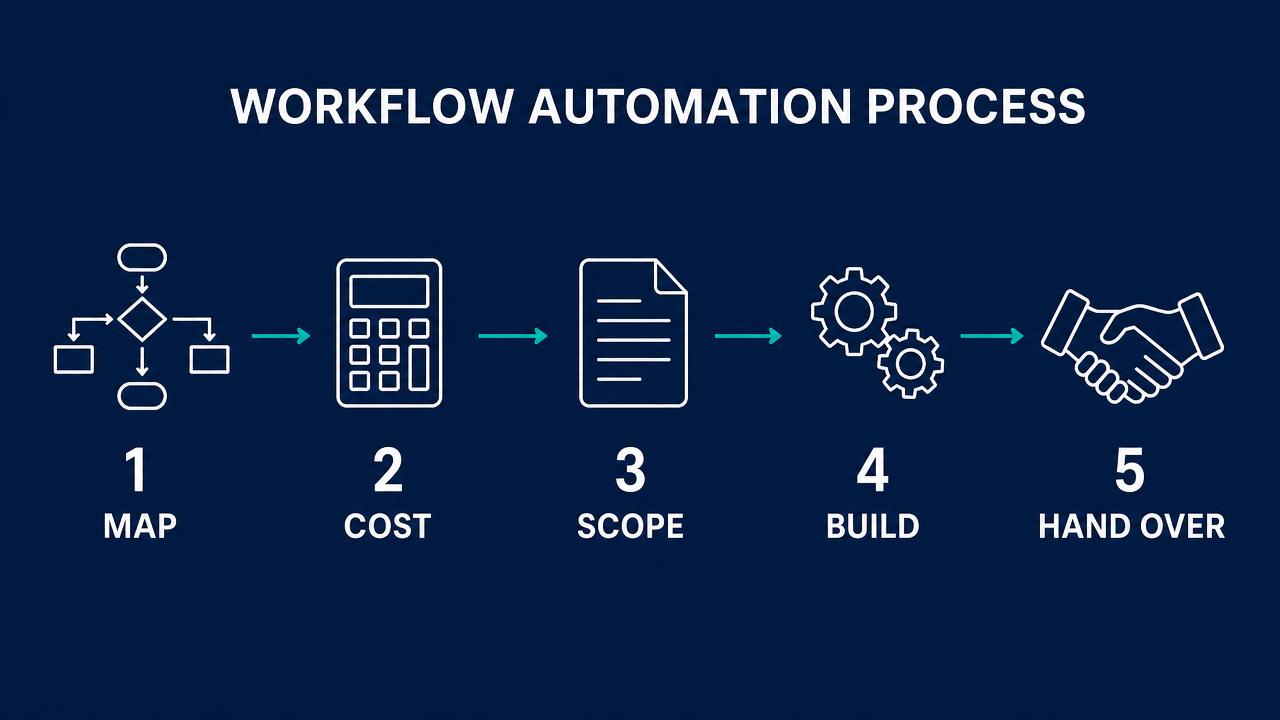
Every engagement follows the same five stages, with a written scope agreed before the build stage begins.
- Map — sit with the people doing the work and record each step as it actually happens, including the workarounds nobody documented.
- Cost — put a time and a frequency against every step, so the business case is arithmetic rather than opinion.
- Scope — agree in writing what will be automated, what stays manual, what the success test is and what it costs.
- Build and test — construct the workflow, run it against real historic data, and compare its output line by line with the manual result.
- Run in parallel and hand over — operate both processes for a week, then switch off the manual one and hand over code, accounts and runbook.
A worked example of the arithmetic
This is how the business case is built. The figures below are the method, not a claim about a specific client — your own numbers go in the same places.
- Count the frequency: how many times a week does this step happen, honestly, across everyone who does it
- Time one instance with a stopwatch rather than an estimate — people usually under-report repetitive work
- Multiply by the loaded hourly cost of the person doing it, not their salary rate
- Add the cost of the errors: the credit notes, the chased invoices, the re-work when a step is missed
- Compare the annual total against the fixed build price and decide with a number in front of you
Signs a process is ready to automate
Five indicators. Two or more of these and it is usually worth scoping.
- The same data is typed into two different systems by the same person
- There is a spreadsheet that exists only to move information between two other tools
- Someone has to remember to do it, and occasionally does not
- The step is described internally as 'just something we have to do'
- A new starter takes weeks to learn it, because it lives in one person's head
What we will not automate
We will say no to some requests. A process nobody can describe consistently is not ready — automating confusion just makes it faster. A step done twice a month rarely repays a build. And anything requiring genuine judgement about a person, a price or a risk stays with a human; we automate the admin surrounding that decision instead of the decision itself.
The three engagement types compared
Digital Bridge's three workflow automation engagements. All prices ex-VAT, fixed scope agreed in writing before work starts.
- Process mapping — Feasibility study — a fixed quote: Yes, across the business. Single workflow — a fixed quote: Yes, for one process. Programme — from €15,000: Yes, across the business.
- Costed business case — Feasibility study — a fixed quote: Yes. Single workflow — a fixed quote: Yes. Programme — from €15,000: Yes.
- Workflows built — Feasibility study — a fixed quote: None. Single workflow — a fixed quote: One. Programme — from €15,000: Several.
- Systems joined — Feasibility study — a fixed quote: Assessed only. Single workflow — a fixed quote: Typically two to three. Programme — from €15,000: Multiple.
- Testing against live data — Feasibility study — a fixed quote: Not applicable. Single workflow — a fixed quote: Yes. Programme — from €15,000: Yes.
- Runbook and training — Feasibility study — a fixed quote: Recommendations. Single workflow — a fixed quote: Yes. Programme — from €15,000: Yes.
- Typical duration — Feasibility study — a fixed quote: Two to three weeks. Single workflow — a fixed quote: Four to six weeks. Programme — from €15,000: Three months or more.
- You own the output — Feasibility study — a fixed quote: Yes. Single workflow — a fixed quote: Yes. Programme — from €15,000: Yes.
| What is included | Feasibility study — €5,000 | Single workflow — €4,500 | Programme — from €15,000 |
|---|---|---|---|
| Process mapping | Yes, across the business | Yes, for one process | Yes, across the business |
| Costed business case | Yes | Yes | Yes |
| Workflows built | None | One | Several |
| Systems joined | Assessed only | Typically two to three | Multiple |
| Testing against live data | Not applicable | Yes | Yes |
| Runbook and training | Recommendations | Yes | Yes |
| Typical duration | Two to three weeks | Four to six weeks | Three months or more |
| You own the output | Yes | Yes | Yes |
How much does workflow automation cost in Dublin?
A single automated workflow is a fixed quote ex-VAT at fixed price. A feasibility study across the business is a fixed quote. Multi-system programmes start at €15,000. Every figure is agreed in writing against a defined scope before work begins.
How long before an automation is live?
Four to six weeks for a single workflow from the point the scope is signed. That includes a week running alongside the manual process, so nothing is switched off until the automated version has matched the human result on live data.
Do we need to change the software we already use?
Usually not. Most accounts packages, CRMs and office suites already expose the connections needed, so we build the joins rather than replacing anything. If a system genuinely has no way in, we tell you at scoping stage, not after a build.
Which processes give the best return?
Frequent, rule-based, repetitive ones. A three-minute task done forty times a week beats a two-hour task done monthly. Quote-to-invoice, client onboarding, enquiry routing and weekly reporting are the four that come up most often.
What happens if the automation stops working?
It stops rather than continuing with bad data, logs what went wrong and alerts a named person. The runbook covers the common failures and their fixes. If you want us involved, changes and support are a fixed quote an hour with a four-hour minimum.
Is there a monthly fee?
No. There is no mandatory retainer and no per-seat licence. You own the code and the accounts outright. Support afterwards is optional and billed by the hour only when you ask for it.
Is this the same as AI?
Not quite. Most of the work is rule-based automation, which is more reliable and cheaper than AI for structured tasks. AI is added only where the input is unstructured — reading a PDF invoice, summarising a long thread, classifying free-text enquiries.
Do you work with businesses outside the city centre?
Yes, across the county and the commuter belt including Swords, Blanchardstown, Tallaght, Sandyford and Dún Laoghaire, and out into Leinster. Mapping sessions can be on site or on a call, whichever suits the people doing the work.
How does workflow automation work for a business in Dublin?
Dublin is the most contested market in the country, with national chains, franchises and well-funded competitors bidding on the same terms a small business relies on. That mix matters for workflow automation, because the most common reason a marketing campaign underperforms has nothing to do with the campaign — it is a lead that waited three days for a reply. For a dublin business, the starting point is a Dublin buyer's own behaviour: what they search for and how far they will travel before choosing someone else. We build automated follow-up on enquiries and quotes, so a lead is contacted within minutes rather than whenever someone gets to the inbox, set up around how Dublin customers behave rather than a generic template. That means starting with the real service area — Swords, Lucan, Tallaght and the south city suburbs — rather than one style for the whole county. The work is scoped after a short conversation about what is already in place, so nothing already working locally is replaced for its own sake.
What makes Dublin different when it comes to workflow automation?
Commuter towns served by the dart and luas — swords, lucan, tallaght — behave as distinct local markets even though they sit inside the same county. That has a direct effect on workflow automation: the most common reason a marketing campaign underperforms has nothing to do with the campaign — it is a lead that waited three days for a reply. The work for a Dublin client looks different from the same service delivered elsewhere in the country — the towns named and the competitors measured against are specific to Dublin, not lifted from a national template. We do not run one fixed package across every county page; the brief for dublin starts with what is actually true here, including places like Swords, Lucan, Tallaght and the south city suburbs, and is adjusted once we can see the business's own enquiry pattern. Reporting stays plain: what changed, over what period, against the baseline agreed before work started.
Where does a Dublin business usually lose the most time to repeated admin?
Almost always at the handovers: an enquiry arrives by email, someone retypes it into a spreadsheet, someone else copies it into an invoicing tool, and a fourth person chases the payment. In a Dublin operation running multiple sites or a hybrid office, those handovers happen across people who are rarely in the same room, so a dropped step is not noticed until a customer complains. Quick Automation, from €4,500, connects the tools you already pay for so a form submission creates the record, sends the confirmation and schedules the follow-up without anyone touching it. We start by mapping the actual path a job takes from first contact to payment, including the informal steps nobody documented, because those are usually where the delay lives. One connected workflow is often enough to give a small team back several hours each week.
We already use a lot of software — will automation just add another system to manage?
That is a fair concern, and the answer is that we connect what you have rather than replacing it. Most Dublin businesses we speak to are running a booking tool, an accounts package and a shared inbox that were each chosen sensibly but never designed to talk to one another. The work is in the joins. For a services firm coordinating field staff across the M50 corridor, that might mean job details flowing from the booking system to the engineer's phone and back again with photos attached. For a wholesaler near the port, it might be stock levels syncing with the online shop overnight. Larger projects move up to Business Automation or a Full Automation Suite where several processes are connected in one piece of work. Anything involving AI decision-making is quoted after a paid discovery assessment, so the scope is understood before money is committed.
What kind of processes do Dublin businesses typically automate first?
Across the Dublin businesses we speak with, the first processes worth automating tend to be the ones generating the most repetitive manual work relative to how simple the actual task is. That commonly includes following up on website enquiries automatically rather than relying on someone remembering to reply, sending appointment or booking confirmations and reminders without manual input, and routing new leads to the correct team or person immediately rather than letting them sit in a general inbox. In a market as fast-moving and competitive as Dublin, delays in responding to an enquiry often mean losing that customer to a competitor who replied faster, so automating the initial response and follow-up stage tends to deliver an immediate, noticeable benefit. Beyond that, businesses often look at automating internal admin, such as updating records after a call or syncing information between different tools they already use. We do not assume every Dublin business needs the same starting point, though — the right first process to automate depends entirely on where your specific workflow is currently losing the most time, which is exactly what our discovery process is built to identify.
How does Digital Bridge decide what to automate for a Dublin business rather than just selling a standard package?
We deliberately do not sell workflow automation as a fixed package, because a generic system built without understanding your actual processes is more likely to waste money than save it, particularly in a market as varied as Dublin, spanning everything from professional services firms in the city centre to retail, hospitality and trades businesses across the suburbs. Instead, every project starts with a paid discovery assessment, where we go through your current tools, your team’s day-to-day workflow, and where the genuine friction points sit — whether that is enquiries going unanswered outside office hours, admin tasks eating into staff time, or information not flowing properly between different systems you already use. This gives us a clear, evidence-based picture of what automation would actually solve, rather than guessing based on assumptions about what a business your size or sector typically needs. From there, we scope and quote a system specifically built around your findings. It takes longer than simply pitching a standard package, but it means what we build actually fits how your Dublin business operates.
How we decide what to quote for Dublin
Digital Bridge delivers this work from Gorey Business Park in County Wexford on a fixed written scope — one price, one delivery date — and the client owns the finished work outright. Workflow automation means replacing the manual steps between your systems — the re-typing, the copy-paste, the chasing — with software that does them the same way every time. Before a figure is given, four questions are answered in order, and a named person signs the scope off — it is never generated automatically.
- Is this the right job at all? We look at what you already have online, whether the domain and Google Business Profile are in your own name, and what Dublin customers currently ask you for. If a repair or a single page would solve it, we quote that instead.
- What does the work have to achieve first? The scope is written around one outcome — enquiries, bookings, orders or credibility — and anything else is listed as optional so it can be dropped without renegotiating.
- What will it cost and when will it be live? Page count, content readiness, integrations and whether photography or copy still has to be produced set the price and the date, both fixed in writing before work starts.
- How will people in Dublin find it afterwards? Local search setup is included in a build; ongoing SEO is a separate optional retainer you can start or stop with notice.
Checkable facts behind this Dublin page
Author and reviewer: Joey Bray, founder of Digital Bridge, building and maintaining Irish business websites since 2016. Studio address: Gorey Business Park, Gorey, Co. Wexford. Phone: 085 224 1848. Every claim below can be checked before you speak to us.
- Published starting prices, not estimates released after a sales call — see the pricing page for the full ladder.
- Live client sites you can open and test yourself are listed in the work section.
- One contact from first call to launch, rather than an account handler relaying messages.
- A plain-text mirror of this page is published for AI assistants at the same path with a .md extension.
Helpful links and official sources for Dublin
Primary sources you can check yourself. We link the publisher rather than a summary of it.
- Trading Online Voucher Scheme — Local Enterprise Office — https://www.localenterprise.ie/Discover-Business-Supports/Trading-Online-Voucher-Scheme/
- SEO starter guide — Google Search Central — https://developers.google.com/search/docs/fundamentals/seo-starter-guide
- Google Business Profile help — https://support.google.com/business/
- Core Web Vitals — web.dev — https://web.dev/articles/vitals
- WCAG 2.2 accessibility guidelines — W3C — https://www.w3.org/TR/WCAG22/
- Data Protection Commission, guidance for organisations — https://www.dataprotection.ie/en/organisations