Custom Business Tools and Apps in Galway
A custom business tool is software written for one company's process instead of rented from a generic platform. Digital Bridge builds booking systems, client portals, quote calculators, job trackers and internal dashboards for firms across the west of Ireland. Scope and price are fixed in writing before development starts, from €2,500 ex-VAT for a single-purpose tool.
Custom Business Tools & Apps in Galway — at a glance
Digital Bridge delivers custom business tools & apps for Galway businesses at a fixed scope and fixed price, owned outright. Remote-first from Gorey, Co. Wexford; on-site when it helps. You receive a written scope and price before any work starts.
- Where: Galway City, Salthill, Oranmore, Athenry, Tuam, Ballinasloe and every other part of County Galway.
- Next step: build a two-minute brief with Zio, or call Joey Bray on 085 224 1848.
How do I brief Digital Bridge quickly from County Galway?
Use the "Build your brief with Zio" button on this page. Zio, the assistant Digital Bridge built into this site, asks what you sell, who buys it, what the custom business tools & apps has to do and when you need it, then writes the brief, emails it to Digital Bridge and sends you a copy. It takes about two minutes and you do not need to know any service names. Digital Bridge replies with a written scope and a fixed price, and delivers to County Galway and every other county in Ireland from Gorey, Co. Wexford. Prefer to talk? Call 085 224 1848.
Recent work by Digital Bridge
Verified live sites designed and built by Digital Bridge, with the real client, location and delivered work identified in each case study.
- Pro Horse Jumps — Equestrian manufacturing and e-commerce (Ireland — nationwide delivery): https://prohorsejumps.ie
- Radiant Heating & Plumbing — Trades — heating, plumbing and gas (Bray, Co. Wicklow — North Wicklow and South Dublin): https://radiantheatingandplumbing.com
- Printhouse.ie — Print, signage and retail (Gorey, Co. Wexford — nationwide delivery): https://printhouse.ie
- GymSafe — Health, safety and compliance (Gorey, Co. Wexford — working nationwide): https://gymsafe.ie
On this page
Jump to any section of this guide.
- Key takeaways
- When is a business ready for software of its own?
- About the author
- What does a custom tool cost in the west, and what moves the price?
- A worked example: quoting and delivery across a spread-out county
- Which tools do businesses on the Atlantic seaboard ask for most?
- Buy a subscription platform or build your own?
- What goes wrong on custom builds, and how we avoid it
- Where is AI genuinely worth adding, and where is it not?
- The five stages of a build, and what you receive at each
- Building for rural coverage, Irish, and seasonal load
- Eight questions to ask before commissioning any build
- How an internal tool still affects how AI assistants describe you
- Renting software versus owning it
- What does a custom business tool cost for a company in Galway?
- How do I know we are ready to move off spreadsheets?
- Will the tool work for crews out in Connemara with poor signal?
- Can the software be bilingual in Irish and English?
- Who owns the software when it is finished?
- What does it cost to run and change after launch?
- Do you need to visit the business, or can this be done remotely?
- What if we outgrow the first version?
Key takeaways
The short version, for readers and answer engines:
- Published fixed prices: single-purpose tool from €2,500 ex-VAT, portal or calculator with logins from €4,250, substantial internal system from €9,500, AI-assisted implementation from €15,000.
- One automated workflow on its own is a fixed quote. A feasibility audit before you commit to anything is a fixed quote.
- Post-launch changes are a fixed quote an hour in 4-hour blocks. There is no monthly software licence.
- The readiness test: the process repeats weekly, involves more than one person, and already has a workaround.
- Terms are 50% deposit and 50% on launch, or 40/30/30 on larger builds, against a signed scope.
- You own the code and the data outright when the final invoice is paid.
When is a business ready for software of its own?
There is a moment every growing firm in the west reaches. The spreadsheet that once tracked ten jobs is now tracking two hundred, three people edit it, and nobody is certain which copy is current. That spreadsheet is not a failure. It is a specification — an accurate, hard-won description of how the business really works, written by the people who do the work.
The readiness test we use has three parts. Does the process repeat every week? Does it involve more than one person? And has someone invented a workaround because no purchased system models it properly? Three yeses and the arithmetic usually favours a build. Two or fewer and we will tell you to keep the spreadsheet and spend the money elsewhere.
What makes the decision sharper on the Atlantic seaboard is distance. A firm quoting in Clifden, delivering in Oranmore and invoicing from an office in the city cannot rely on people standing near each other to keep information straight. Software that holds one shared record earns its place faster where the team is spread out.
- One shared record that field staff, office staff and clients each see through their own permitted view
- Written to match a process you already run, rather than forcing the process to match a platform
- Source code and database handed over on completion — no per-seat licence, no vendor able to reprice you
- Fixed written scope, fixed price and an agreed delivery date before development begins
- Works on a phone with poor signal in rural Connacht, syncing when the connection returns
- Bilingual interface where a Gaeltacht business needs Irish and English side by side
- Data exportable at any time to CSV, spreadsheet or your accounts package
- Documented well enough that another developer could pick it up tomorrow
What does a custom tool cost in the west, and what moves the price?
The ladder is published rather than quoted case by case. A single-purpose tool begins at a fixed quote ex-VAT. A portal or calculator with logins and stored history begins at a fixed quote. A substantial internal system begins at a fixed quote. An AI-assisted implementation begins at a fixed quote, and a single automated workflow on its own is a fixed quote.
Three factors decide where inside a band a build lands. User types come first: one staff login is straightforward, whereas clients, crews and administrators each needing a different view multiplies the screens. Integration comes second — reading from an accounts package, a payment provider or an existing database is more work than storing data fresh. Historic data comes third, because importing years of spreadsheet rows cleanly, with the duplicates resolved, is a task in its own right. Hosting after launch is a modest monthly figure that we state in euro in the scope, not after go-live.
A worked example: quoting and delivery across a spread-out county
Picture a supplier with a yard outside Tuam, a showroom in the city and vans covering Connemara and east Connacht. A customer rings for a price. Someone measures, checks a rate card, works out delivery by distance, types a quote into a document and emails it. If it is accepted, the details are re-typed into a delivery schedule, then again into the accounts package.
A quote and delivery tool collapses that into one record. The rate card and the distance bands live in the software, so the price is calculated rather than recalled. An accepted quote becomes a delivery job without anyone re-typing an address. The driver marks it complete on a phone, and the invoice draws from the finished job. The office stops ringing vans to ask what happened, because the record already says.
In that single change the rate card stops being recalled from memory, delivery charges stop being estimated, customer details stop being typed three times, and the invoice draws directly from the completed job so the figures cannot drift apart.
Which tools do businesses on the Atlantic seaboard ask for most?
Requests cluster around a handful of shapes. Appointment and resource booking for clinics, studios and equipment hire. Client portals for professional and financial services, where documents, approvals and status replace a long email thread. Quote calculators wherever price depends on measurement, options or travel. Job and works trackers for field teams. Stock, asset or fleet registers. Reporting dashboards that assemble numbers currently gathered by hand. And integration layers that make two systems you already pay for exchange data.
Seasonality shapes the brief here more than it does inland. Tourism, marine and hospitality operators along the coast carry a fierce summer peak and a quiet winter, so tools get built to absorb the peak — self-service booking, automatic confirmations, waiting lists — rather than to add administration during the months when nobody has a spare hour.
Buy a subscription platform or build your own?
Buying wins whenever the process is standard and well modelled: payroll, accounting, email marketing and general file storage are rarely worth building. Building wins when the process is specific to your firm, when per-seat fees across a large team have grown past the cost of ownership, when two subscriptions must be reconciled by hand each month, or when a workaround has quietly become official procedure.
Count the workarounds honestly. Every spreadsheet, shared document or WhatsApp group that exists to patch a system you already pay for is evidence the system does not fit. Those patches are also the most useful specification you can bring to a first meeting. The comparison further down sets rented and owned software side by side on cost, fit, ownership and exit.
What goes wrong on custom builds, and how we avoid it
Failures follow a pattern. A scope that tries to replace everything at once instead of fixing the single most expensive process. A specification written with managers but not with the people who use the thing daily. Data migration left until the final week, when it is the task most likely to overrun. A tool designed around one individual rather than a role, which breaks the week they leave. And a launch with no written handover of code, hosting and database credentials.
Our answer is deliberately unambitious first versions. We build the one process with the clearest cost, get it live, let people use it for a few weeks, and let real usage shape phase two. A working tool is a far better brief for the next stage than a specification nobody has tested.
Where is AI genuinely worth adding, and where is it not?
AI earns its place where a task involves reading unstructured text or exercising routine judgement: triaging inbound enquiries, drafting a first-pass quote from an email, turning rough site notes into a structured job record, or flagging an invoice that looks out of pattern. It does not earn its place where a plain rule is sufficient — a reminder two days before an appointment needs a date comparison, not a language model.
One automated workflow is a fixed quote. A feasibility audit that tells you what is worth automating before you commit is a fixed quote, and full implementations start from €15,000. Anything we build that touches money or a customer keeps a human approval step, and shows the reasoning behind its suggestion rather than presenting an answer with no working.
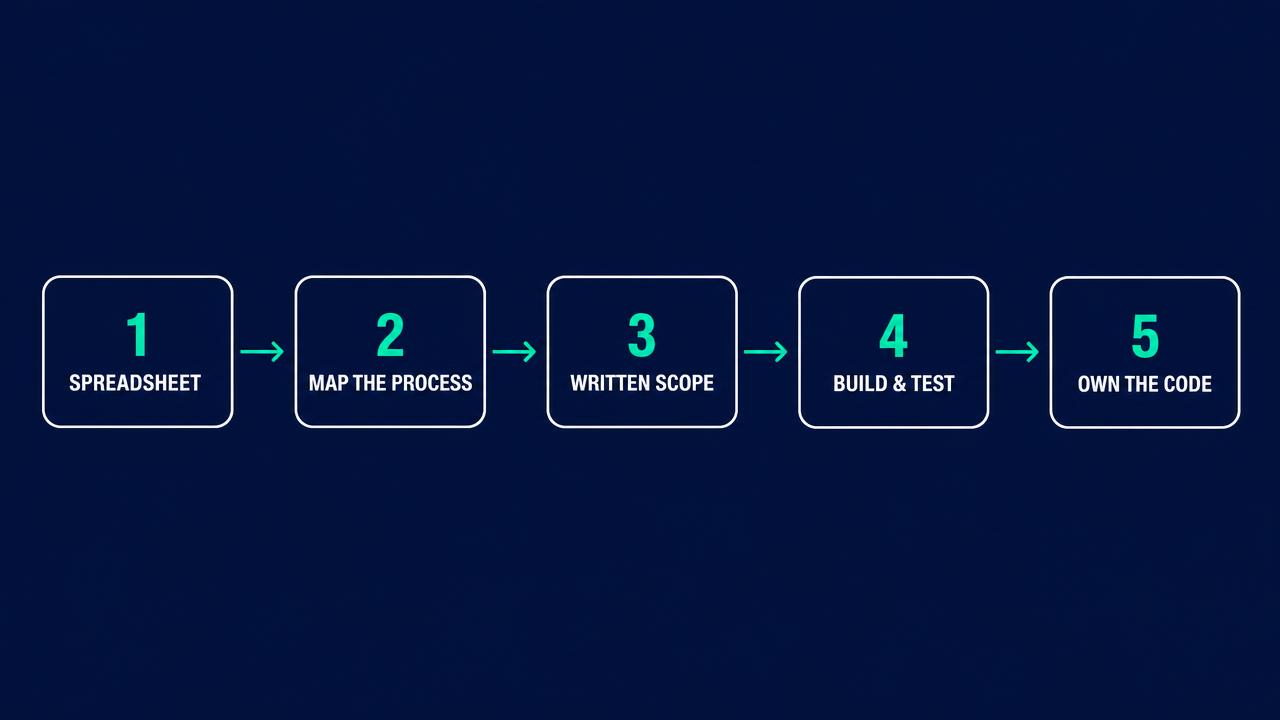
The five stages of a build, and what you receive at each
Every build runs through the same five stages, each ending in a written deliverable you approve before the next begins. We work on-site with businesses across the county and remotely where that suits better.
- Process mapping: a half-day with the people doing the work, recording how the job actually runs and where the hours disappear.
- Fixed written scope: every screen, role, rule and integration listed, priced and dated. Nothing is built until you sign it.
- Clickable structure: a navigable outline of the tool, so the shape is corrected before development time is spent on it.
- Staged build and testing: developed in reviewable stages and tested against your own records rather than sample data.
- Launch, training and handover: live on your domain, your team trained, and source code, hosting and database credentials transferred to you in writing.
Building for rural coverage, Irish, and seasonal load
Three practical constraints come up here more than they do in the east, and each one changes how a tool is built rather than merely how it looks.
- Offline tolerance: forms hold their contents on a phone in poor coverage and submit when signal returns, instead of losing an afternoon's entries
- Bilingual interface: Irish and English labels where a Gaeltacht business or public-sector contract requires them, held in one place so wording stays consistent
- Seasonal load: booking and enquiry tools sized for the summer peak rather than the January average
- Low-bandwidth pages: lightweight screens so a tool remains usable on a rural mobile connection
- Printable fallbacks: job sheets that can still be printed for anyone who prefers paper on site
Eight questions to ask before commissioning any build
Ask these of us or of any developer you are considering. Each is answered in writing inside our scope document, and an unwillingness to answer any of them is a warning worth heeding.
- Is the scope written screen by screen, with a fixed price and a delivery date attached?
- Who owns the source code once the final invoice is paid, and is that stated in writing?
- Where does the data live, under which jurisdiction, and who holds access to it?
- What is the itemised monthly running cost after launch, in euro?
- How is existing data migrated, and who verifies it came across correctly?
- Could another developer take the project over, and what documentation would they receive?
- How are post-launch changes priced? Ours are a fixed quote an hour, in 4-hour blocks.
- What is the GDPR position on personal data, including retention periods and deletion?
How an internal tool still affects how AI assistants describe you
Internal software is not indexed, but everything public that hangs off it is. Assistants such as ChatGPT, Perplexity and Google's AI summaries assemble a picture of a firm from every consistent source they can find. Contradictions between a booking page, a website and a Google Business Profile make an assistant hedge, and a hedged answer rarely turns into an enquiry.
- Public screens — a booking page or an open quote calculator — are server-rendered so they can be read without JavaScript
- Trading name, address, phone number and opening hours stated identically everywhere they appear
- Structured data describing only what is genuinely on the page, never markup for absent content
- Alt text written as a plain description of the image rather than a list of search terms
Renting software versus owning it
A rented platform and a purpose-built tool compared for a business trading across the west.
- Upfront cost — Subscription platform: Little or nothing. Custom tool from Digital Bridge: a fixed quote to a fixed quote ex-VAT, fixed before work starts.
- Cost as the team grows — Subscription platform: Rises with every additional seat. Custom tool from Digital Bridge: Unchanged — hosting only, plus changes at a fixed quote.
- Fit to your process — Subscription platform: You adapt, usually with a spreadsheet covering the gaps. Custom tool from Digital Bridge: Written around the process you already run.
- Rural and offline use — Subscription platform: Whatever the vendor happens to support. Custom tool from Digital Bridge: Built to tolerate poor coverage and sync later.
- Ownership — Subscription platform: You rent access for as long as you pay. Custom tool from Digital Bridge: You own the code and the data.
- Irish-language support — Subscription platform: Rarely offered. Custom tool from Digital Bridge: Built in where the business needs it.
- Leaving — Subscription platform: Export whatever the platform permits, when it permits it. Custom tool from Digital Bridge: Full export at any time; another developer can take it on.
- Time to first use — Subscription platform: Immediate, before configuration and workarounds. Custom tool from Digital Bridge: Weeks, against a date written into the scope.
| Factor | Subscription platform | Custom tool from Digital Bridge |
|---|---|---|
| Upfront cost | Little or nothing | €2,500 to €15,000+ ex-VAT, fixed before work starts |
| Cost as the team grows | Rises with every additional seat | Unchanged — hosting only, plus changes at €95/hour |
| Fit to your process | You adapt, usually with a spreadsheet covering the gaps | Written around the process you already run |
| Rural and offline use | Whatever the vendor happens to support | Built to tolerate poor coverage and sync later |
| Ownership | You rent access for as long as you pay | You own the code and the data |
| Irish-language support | Rarely offered | Built in where the business needs it |
| Leaving | Export whatever the platform permits, when it permits it | Full export at any time; another developer can take it on |
| Time to first use | Immediate, before configuration and workarounds | Weeks, against a date written into the scope |
What does a custom business tool cost for a company in Galway?
A single-purpose tool starts at €2,500 ex-VAT, a portal or calculator with logins from €4,250, a substantial internal system from €9,500, and an AI-assisted implementation from €15,000. A single automated workflow is a fixed quote. Each price is fixed against a written scope before any work begins.
How do I know we are ready to move off spreadsheets?
Apply three tests. The process repeats at least weekly, more than one person touches it, and someone has already invented a workaround because no purchased system handles it properly. Three yeses and a build usually pays for itself. Fewer than three and we will advise you to keep the spreadsheet.
Will the tool work for crews out in Connemara with poor signal?
Yes. Where field use is part of the scope, forms retain their contents on the device when coverage drops and submit automatically once the connection returns. Screens are kept lightweight so they load on a slow rural mobile connection.
Can the software be bilingual in Irish and English?
Yes. Interface text can be held in both languages, with a single place to edit wording so the two never drift apart. This matters for Gaeltacht businesses and for organisations working to public-sector language obligations.
Who owns the software when it is finished?
You do. Once the final invoice is paid, the source code, the database and the hosting credentials are transferred to you in writing. There is no per-seat licence and nothing that requires you to keep working with us.
What does it cost to run and change after launch?
Hosting and a database are a modest monthly figure that we state in euro inside the scope rather than after launch. Changes afterwards are a fixed quote an hour in 4-hour blocks, with no retainer required.
Do you need to visit the business, or can this be done remotely?
Both work. Process mapping is usually better done in person, because watching the job run surfaces steps nobody thinks to describe. Development, review sessions and training then run remotely unless you prefer otherwise. We travel across Connacht for the mapping stage.
What if we outgrow the first version?
That is the intended path. First versions are deliberately narrow so the tool is live and earning quickly. Phase two is scoped and priced separately once real usage has shown what the business actually needs next, rather than being guessed at up front.
How does custom business tools work for a business in Galway?
Galway pairs a compact, tech-heavy city economy around ballybrit and parkmore with a large, dispersed rural and gaeltacht county where connectivity and travel time vary sharply from parish to parish. That mix matters for custom business tools, because marketing spend is wasted when the enquiry that a campaign generates lands in an inbox nobody checks or a form with no follow-up. For a galway business, the starting point is a Galway buyer's own behaviour: what they search for and how far they will travel before choosing someone else. We build a booking form, quote calculator or lead-tracking sheet built to match how the business actually takes enquiries, rather than a generic contact form, set up around how Galway customers behave rather than a generic template. That means starting with the real service area — Oughterard, Tuam, Loughrea and the Gaeltacht villages west of the city — rather than one style for the whole county. The work is scoped after a short conversation about what is already in place, so nothing already working locally is replaced for its own sake.
What makes Galway different when it comes to custom business tools?
Galway's tourism economy runs on the arts festival calendar and connemara visitor traffic, which produces sharp seasonal swings a year-round trades business does not see. That has a direct effect on custom business tools: marketing spend is wasted when the enquiry that a campaign generates lands in an inbox nobody checks or a form with no follow-up. The work for a Galway client looks different from the same service delivered elsewhere in the country — the towns named and the competitors measured against are specific to Galway, not lifted from a national template. We do not run one fixed package across every county page; the brief for galway starts with what is actually true here, including places like Oughterard, Tuam, Loughrea and the Gaeltacht villages west of the city, and is adjusted once we can see the business's own enquiry pattern. Reporting stays plain: what changed, over what period, against the baseline agreed before work started.
We run a guesthouse in Clifden — can you build us a simple booking tool instead of paying commission to OTAs?
We can build a direct booking tool tied to your own website so guests can check availability and pay a deposit without you handing a cut to a booking platform every time. This matters most in Connemara, where trade swings hard between a packed Race Week and Arts Festival summer and a much quieter winter, so keeping every booking margin intact counts. The tool can show your real-time calendar, take deposits, and send automatic confirmation emails, cutting down the back-and-forth you currently manage by phone or email between check-ins. We build these as part of a custom project scoped to your actual booking volume and payment needs, so pricing depends on complexity rather than a fixed package. For guesthouses juggling multiple room types or seasonal pricing, we can also add simple rules so rates adjust automatically around known busy weekends without you manually updating a spreadsheet each month.
Our fish exporter in the Claddagh needs a quoting tool for buyers across Europe
Exporting from the Claddagh or the docks means dealing with buyers who want quick, accurate quotes in their own currency, often with catch details and delivery timing attached. A custom quoting tool replaces the spreadsheet-and-email routine with a simple form your team fills in once, generating a professional quote automatically with the right currency conversion and your standard terms attached. This cuts the time between a buyer’s enquiry and your reply, which matters when a competitor in another port might answer first. We can also link basic catch or stock records so quotes reflect what’s actually available rather than guesswork. Every business we build this for has different suppliers, certifications and paperwork requirements, so we scope the tool around your actual process rather than a generic template. As with all custom tools, cost depends on scope, and we’ll give you a clear quote before any build work starts.
What custom business tools do you build for companies operating around Galway?
It depends entirely on what’s slowing your business down, which is why we start every project with a paid discovery assessment rather than a template pitch. For Galway city businesses in tourism, hospitality or the medtech and tech sectors clustered around the city, that might mean a booking system tailored to your exact process, a quoting tool that pulls from your own pricing rules, or a simple portal for customers to track an order or enquiry. For businesses further out in Tuam, Athenry or Loughrea, we often see a need for tools that connect a website enquiry form directly to how the business already manages jobs, whether that’s a shared spreadsheet, an email inbox or basic scheduling software. Rather than forcing you onto generic off-the-shelf software that half-fits your process, we build something shaped around how you actually work, so your team doesn’t have to change habits to accommodate the tool. We’re upfront that custom tools cost more than a template site, but the assessment gives you a clear, honest quote before any commitment, based on what the tool needs to actually do.
How long does it take to build a custom tool for a Galway business, from first chat to going live?
The paid discovery assessment itself usually takes the shortest part of the timeline — it’s where we map your current process, identify what a tool needs to do, and give you an honest quote and realistic schedule. Build time after that varies a lot depending on complexity: a straightforward booking or enquiry tool for a Galway city hospitality business can be quicker to deliver than something for a Tuam or Athenry business with more complex quoting rules or multiple staff workflows to account for. We test everything against real scenarios before it goes live, because a half-working tool causes more disruption than the manual process it replaces, and Galway businesses dealing with seasonal tourism surges or festival-time demand don’t have room for downtime while we fix issues. We also plan launch timing around your calendar — a tourism business wouldn’t want a new booking system going live the week before the Galway Races or the summer festival season, for instance. Once live, we stay involved to adjust the tool as your business changes rather than treating it as a one-off delivery.
How we decide what to quote for Galway
Digital Bridge delivers this work from Gorey Business Park in County Wexford on a fixed written scope — one price, one delivery date — and the client owns the finished work outright. A custom business tool is software written for one company's process instead of rented from a generic platform. Before a figure is given, four questions are answered in order, and a named person signs the scope off — it is never generated automatically.
- Is this the right job at all? We look at what you already have online, whether the domain and Google Business Profile are in your own name, and what Galway customers currently ask you for. If a repair or a single page would solve it, we quote that instead.
- What does the work have to achieve first? The scope is written around one outcome — enquiries, bookings, orders or credibility — and anything else is listed as optional so it can be dropped without renegotiating.
- What will it cost and when will it be live? Page count, content readiness, integrations and whether photography or copy still has to be produced set the price and the date, both fixed in writing before work starts.
- How will people in Galway find it afterwards? Local search setup is included in a build; ongoing SEO is a separate optional retainer you can start or stop with notice.
Checkable facts behind this Galway page
Author and reviewer: Joey Bray, founder of Digital Bridge, building and maintaining Irish business websites since 2016. Studio address: Gorey Business Park, Gorey, Co. Wexford. Phone: 085 224 1848. Every claim below can be checked before you speak to us.
- Published starting prices, not estimates released after a sales call — see the pricing page for the full ladder.
- Live client sites you can open and test yourself are listed in the work section.
- One contact from first call to launch, rather than an account handler relaying messages.
- A plain-text mirror of this page is published for AI assistants at the same path with a .md extension.
Helpful links and official sources for Galway
Primary sources you can check yourself. We link the publisher rather than a summary of it.
- Trading Online Voucher Scheme — Local Enterprise Office — https://www.localenterprise.ie/Discover-Business-Supports/Trading-Online-Voucher-Scheme/
- SEO starter guide — Google Search Central — https://developers.google.com/search/docs/fundamentals/seo-starter-guide
- Google Business Profile help — https://support.google.com/business/
- Core Web Vitals — web.dev — https://web.dev/articles/vitals
- WCAG 2.2 accessibility guidelines — W3C — https://www.w3.org/TR/WCAG22/
- Data Protection Commission, guidance for organisations — https://www.dataprotection.ie/en/organisations