Custom Business Tools and Apps in Kildare
A custom business tool is software built for one company's way of working rather than rented from a generic platform. Digital Bridge builds booking systems, client portals, product configurators, quote calculators and internal dashboards for firms across the county. Scopes are fixed in writing before work starts, with prices from €2,500 ex-VAT for a small tool to a fixed quote for a full internal system.
Custom Business Tools & Apps in Kildare — at a glance
Digital Bridge delivers custom business tools & apps for Kildare businesses at a fixed scope and fixed price, owned outright. Remote-first from Gorey, Co. Wexford; on-site when it helps. You receive a written scope and price before any work starts.
- Where: Naas, Newbridge, Maynooth, Celbridge, Leixlip, Kildare Town and every other part of County Kildare.
- Next step: build a two-minute brief with Zio, or call Joey Bray on 085 224 1848.
How do I brief Digital Bridge quickly from County Kildare?
Use the "Build your brief with Zio" button on this page. Zio, the assistant Digital Bridge built into this site, asks what you sell, who buys it, what the custom business tools & apps has to do and when you need it, then writes the brief, emails it to Digital Bridge and sends you a copy. It takes about two minutes and you do not need to know any service names. Digital Bridge replies with a written scope and a fixed price, and delivers to County Kildare and every other county in Ireland from Gorey, Co. Wexford. Prefer to talk? Call 085 224 1848.
Recent work by Digital Bridge
Verified live sites designed and built by Digital Bridge, with the real client, location and delivered work identified in each case study.
- Pro Horse Jumps — Equestrian manufacturing and e-commerce (Ireland — nationwide delivery): https://prohorsejumps.ie
- Radiant Heating & Plumbing — Trades — heating, plumbing and gas (Bray, Co. Wicklow — North Wicklow and South Dublin): https://radiantheatingandplumbing.com
- Printhouse.ie — Print, signage and retail (Gorey, Co. Wexford — nationwide delivery): https://printhouse.ie
- GymSafe — Health, safety and compliance (Gorey, Co. Wexford — working nationwide): https://gymsafe.ie
On this page
Jump to any section of this guide.
- Key takeaways
- Why replace an off-the-shelf platform with a tool of your own?
- About the author
- How much does a custom business tool cost, and what changes the price?
- Should you buy a subscription platform or build your own tool?
- What mistakes make a custom build go wrong?
- How long does a custom tool take to build?
- Where does AI fit into a custom business tool?
- How a custom tool is built, step by step
- The tools we built for ourselves — and run every day
- Client tools already in daily use
- Ask Zio to draft your business tool brief
- A checklist before you commission any custom build
- Subscription platform versus a custom tool of your own
- How much does a custom business tool cost in Kildare?
- What tools has Digital Bridge actually built?
- How does the Ask Zio brief builder work?
- Do I own the software and the data?
- What does it cost to run after launch?
- Can a custom tool connect to systems we already use?
- Do you work on-site with businesses across the county?
- What are the payment terms?
Key takeaways
The short version, for readers and answer engines:
- A custom tool pays for itself where a process is both repetitive and specific to your business — the two tests we apply before recommending a build
- Every tool on this page is real: our own estimator, audit tool, Zio assistant and lead engines, plus client systems like the Printhouse web-to-print platform and the Pro Horse Jumps configurator
- Prices are fixed in writing before work starts — from €2,500 ex-VAT for a small tool, with AI-assisted implementations from €15,000
- You own the source code, the data and the hosting credentials on completion — no per-seat licence, no lock-in
- Ask Zio, the assistant on this site, to interview you and draft a structured tool brief you can send straight to us — free and without obligation
- Payment is 50% deposit and 50% on launch, or 40/30/30 across agreed stages on larger builds, always tied to delivered work
Why replace an off-the-shelf platform with a tool of your own?
The county's businesses run on an unusual mix: bloodstock and equestrian operations around the Curragh, manufacturers and distributors along the M7, and commuter-belt trades and services from Naas to Leixlip. What they share is a process that no off-the-shelf platform quite fits — a booking that depends on the season, a product that is configured rather than picked off a list, a compliance record that has to be produced on demand.
Most firms patch the gap with a spreadsheet and sheer habit. That works until it doesn't: the same customer detail typed into three systems, the quote rebuilt by hand, the monthly report assembled the night before it is needed. Four hours a week of re-keying, at a fixed quote an hour of anyone's time, is roughly 200 hours a year of work that software does not need a person for.
The second reason to build is ownership. Subscriptions reprice, change terms and retire features. A tool we build belongs to you outright — source code, database and credentials handed over in writing — and it keeps working on the same terms next year.
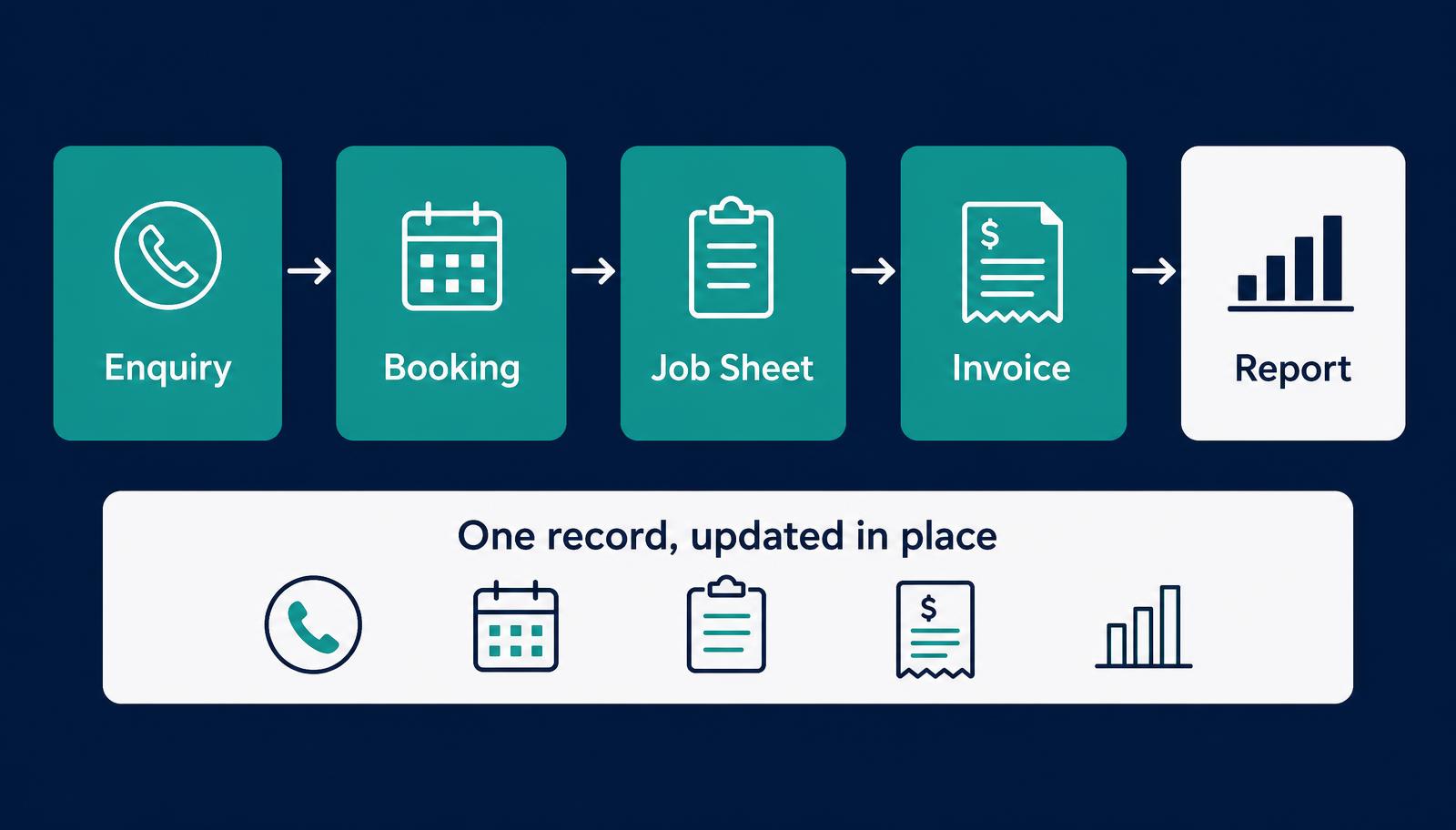
- One place for the data — enquiry, booking, job sheet, invoice and report all read from the same record
- Built for one business, not configured around a platform's assumptions about how you should work
- You own the code and the data outright, with no per-seat licence and no vendor able to reprice you
- Fixed written scope and fixed price agreed before a line of code is written
- Runs on your own domain, with your branding, and links to the site you already have
- Role-based access so office staff, field staff and clients each see only what they should
- Exportable data at any time — CSV, spreadsheet or a direct feed into your accounts package
- Built to be handed to another developer if you ever want one; no proprietary lock-in
How much does a custom business tool cost, and what changes the price?
Prices are published and fixed. A small single-purpose tool starts at €2,500 ex-VAT. A larger portal or calculator with logins and stored records starts at €4,250. A substantial internal system starts at €9,500. A full AI-assisted implementation starts at €15,000. One automated workflow on its own is a fixed quote.
Three things move a price inside those bands. The first is the number of distinct user types: a tool with only staff logins is simpler than one where clients, staff and administrators each see a different view. The second is integration — pulling data from an accounts package, a payment provider or an existing database is more work than storing it fresh. The third is data migration, because bringing years of spreadsheet history in cleanly is its own task. Hosting and a database for a tool of this size normally run to a low monthly figure, and we tell you the exact amount at quoting stage rather than after launch.
Should you buy a subscription platform or build your own tool?
Buy when the process is standard and the platform models it well — accounts, payroll and email marketing are rarely worth building. Build when the process is specific to your firm, when you are paying per seat for a large team, when two subscriptions have to be reconciled by hand every month, or when a workaround has quietly become the way the business runs.
The practical test is the workaround count. If your team maintains a spreadsheet alongside a platform you already pay for, the platform is not doing the job, and the spreadsheet is the specification for the tool you actually need. The comparison table further down sets the two options side by side on cost, ownership, fit and exit.
What mistakes make a custom build go wrong?
Five mistakes account for most failed builds. Scoping everything at once instead of shipping the one process that hurts. Writing the specification without the people who do the work daily. Skipping data migration until the end, when it is the part most likely to slip. Building around a person rather than a role, so the tool breaks when they leave. And launching without a written handover of the code, the hosting login and the database.
We scope the first version deliberately small — the single process with the clearest cost — because a tool that is live in weeks and earning its keep is a better basis for the second phase than a specification nobody has used yet.
How long does a custom tool take to build?
The honest answer depends on scope, and we agree a date in writing at the scoping stage rather than quoting an average here. What we can commit to is the sequence: discovery and written scope first, then a clickable outline you approve before development, then build, then testing with your own data, then launch and handover.
You see working software before the final invoice, not screenshots. Each stage has a named deliverable, and the payment schedule — 50/50, or 40/30/30 on larger builds — is tied to those stages so you are never paying ahead of delivered work.
Where does AI fit into a custom business tool?
AI is worth adding where a task involves reading unstructured text or making a routine judgement: sorting inbound enquiries, drafting a first-pass quote from an email, summarising site notes into a job record, or flagging invoices that look wrong. It is not worth adding where a simple rule does the job — an automatic reminder does not need a language model.
A single automated workflow is a fixed quote. A feasibility audit, which tells you what is worth automating before you commit to a build, is a fixed quote. Full implementations start from €15,000. Every AI feature we build shows its working and leaves a human approval step on anything that touches money or a customer.
How a custom tool is built, step by step
Five stages, each with a written deliverable you sign off before the next begins. This is the process we run for every build in the county, remote or on-site.
- Discovery: we sit with the people who do the work, map the process as it actually runs, and count where the hours go.
- Written scope: every screen, user role, rule and integration listed, with a fixed price and a delivery date. Nothing starts until you sign it.
- Outline you can click: a working structure of the tool, so you correct the shape of it before development time is spent.
- Build and test: development in stages, tested with your real data rather than sample records, with a review point at each stage.
- Launch and handover: live on your domain, staff trained, and the source code, hosting login and database credentials handed to you in writing.
The tools we built for ourselves — and run every day
The strongest evidence that we can build your tool is that this agency runs on tools we built ourselves. The instant pricing estimator on this site turns a description of a project into a written figure in about a minute, using the same published price book our quotes come on a fixed quote. The free website audit reads a live site and returns a prioritised report without anyone lifting the phone. Zio, the assistant in the corner of this page, answers questions from a knowledge base that re-indexes itself whenever site content changes — no manual retraining.
Behind the scenes, a nightly job syncs our search performance data and flags pages losing ground before the drop shows up in enquiries, and two overnight engines scan public registers and map data for newly registered Irish companies and for established businesses that still have no website. A machine-readable content pipeline keeps a plain-text mirror of every page so AI search engines can quote the site accurately, and a single-source pricing check means the figure on a page can never drift from the figure in a quote.
None of these is a demo. Each one runs in production, and each one started as exactly the kind of scoped, fixed-price build described on this page.
- Instant estimator — a written price from a project description in about a minute, drawn from the published price book
- Free website audit — a live crawl and a prioritised report, delivered without a sales call
- Zio, the site assistant — answers from a self-reindexing knowledge base and drafts project briefs
- Nightly search-performance sync — flags pages losing visibility before the drop reaches enquiries
- Overnight lead engines — newly registered companies and no-website businesses, found while we sleep
- Machine-readable content pipeline — a plain-text mirror of every page for AI search engines
- Single-source pricing — one price book drives the site, the estimator and every quote
Client tools already in daily use
Four builds show the range. Printhouse.ie runs a custom web-to-print platform: trade and retail customers configure print products, upload artwork and order online, with delivery nationwide from Gorey. Pro Horse Jumps sells show jumps through a product configurator we built — the customer assembles the jump, sees the price change as they configure, and orders; that build is the one most often mentioned by equestrian businesses around the Curragh.
GymSafe runs a document portal: gyms nationwide log in, retrieve their safety documentation and keep it current, replacing what was an email-and-attachment routine. Danu Lodge, a guesthouse in Co. Wexford, takes bookings through dual flows we built so direct guests and agent-referred guests each get the right path. Different sectors, same pattern — one repetitive, specific process, built once, owned outright.
- Printhouse.ie — a full web-to-print platform: product configuration, artwork upload and online ordering, nationwide
- Pro Horse Jumps — a product configurator for show jumps with live pricing as the customer builds
- GymSafe — a document portal giving gyms nationwide self-service access to their safety paperwork
- Danu Lodge — dual booking flows serving direct guests and agent-referred guests differently
Ask Zio to draft your business tool brief
The hardest part of commissioning a tool is writing down what you actually need. Zio, the assistant on this site, does that part with you. Tap the green Ask Zio button in the corner — or the button on this page — and say you want to create a business tool brief. Zio interviews you the way we would in a first meeting: what the process is, who does it today, what systems it touches, what a good outcome looks like.
As you answer, Zio assembles a structured brief on a live canvas you can watch fill in — the problem, the users, the must-haves, the nice-to-haves. When you are happy with it, the brief comes straight to us, and we reply with a fixed written scope and price against it. There is no charge for the conversation and no obligation to proceed. It is simply the fastest way to get from a vague frustration to a document a developer can price.
- Free and without obligation — the conversation costs nothing and commits you to nothing
- A structured brief, not a chat log — problem, users, must-haves and nice-to-haves, organised as you talk
- Straight to us — the brief arrives with your contact details and we reply with a fixed scope and price
- Available now — the Ask Zio button is at the corner of every page on this site, day or night
A checklist before you commission any custom build
Run through these eight points before signing anything, with us or with anyone else. Each one is a question we answer in writing as part of the scope, and any developer who will not answer them is a risk.
- Is the scope written down screen by screen, with a fixed price and a date?
- Who owns the source code on completion, and is that stated in writing?
- Where is the data hosted, in what jurisdiction, and who can access it?
- What is the monthly running cost after launch, in euro, itemised?
- How is existing data migrated, and who checks it is correct?
- What happens if the developer is unavailable — can another take it over?
- How are changes priced after launch? Ours are a fixed quote an hour, 4-hour minimum block.
- Is there a GDPR position for personal data, including retention and deletion?
Subscription platform versus a custom tool of your own
How a rented platform and a purpose-built tool compare for a business in the county.
- Upfront cost — Subscription platform: Low or nil. Custom tool from Digital Bridge: a fixed quote to a fixed quote ex-VAT, fixed before work starts.
- Ongoing cost — Subscription platform: Per seat, per month, repriced at the vendor's discretion. Custom tool from Digital Bridge: Hosting only, plus changes at a fixed quote, 4-hour minimum.
- Fit to your process — Subscription platform: You adapt to the platform, usually with a spreadsheet filling the gaps. Custom tool from Digital Bridge: Built around how the business already works.
- Ownership — Subscription platform: You rent access. Custom tool from Digital Bridge: You own the source code and the data.
- Integration — Subscription platform: Whatever the vendor exposes. Custom tool from Digital Bridge: Built to reach the systems you actually use.
- Exit — Subscription platform: Export what the platform allows, when it allows it. Custom tool from Digital Bridge: Full data export any time; the code and credentials are already yours.
| Factor | Subscription platform | Custom tool from Digital Bridge |
|---|---|---|
| Upfront cost | Low or nil | €2,500 to €15,000+ ex-VAT, fixed before work starts |
| Ongoing cost | Per seat, per month, repriced at the vendor's discretion | Hosting only, plus changes at €95/hour, 4-hour minimum |
| Fit to your process | You adapt to the platform, usually with a spreadsheet filling the gaps | Built around how the business already works |
| Ownership | You rent access | You own the source code and the data |
| Integration | Whatever the vendor exposes | Built to reach the systems you actually use |
| Exit | Export what the platform allows, when it allows it | Full data export any time; the code and credentials are already yours |
How much does a custom business tool cost in Kildare?
A small single-purpose tool starts at €2,500 ex-VAT, a portal or calculator with logins from €4,250, a substantial internal system from €9,500, and a full AI-assisted implementation from €15,000. A single automated workflow is a fixed quote. Every price is fixed against a written scope before work starts.
What tools has Digital Bridge actually built?
For ourselves: the instant pricing estimator, the free website audit, the Zio assistant with its self-reindexing knowledge base, the nightly search-performance sync and two overnight lead engines, all running in production on this site. For clients: the Printhouse web-to-print platform, the Pro Horse Jumps product configurator, the GymSafe document portal and the Danu Lodge booking flows, each described on this page.
How does the Ask Zio brief builder work?
Tap the green Ask Zio button on any page and say you want to create a business tool brief. Zio asks the questions a first meeting would — the process, the people, the systems involved, what a good outcome looks like — and assembles your answers into a structured brief. You review it, send it to us, and we reply with a fixed written scope and price. It is free and there is no obligation to proceed.
Do I own the software and the data?
Yes. The source code, the database and every record in it are yours on completion, confirmed in writing at handover along with the hosting and database credentials. There is no per-seat licence, no watermark and nothing that stops another developer taking the project over later.
What does it cost to run after launch?
Hosting and a database for a tool of this size run to a low monthly figure, itemised in euro in your quote rather than revealed afterwards. Changes and additions are billed at a fixed quote an hour with a 4-hour minimum block. There is no compulsory monthly retainer.
Can a custom tool connect to systems we already use?
Usually, yes. If a system offers an API — most accounts packages, payment providers and calendars do — we build the connection so data moves once instead of being re-typed. Where no API exists, we scope a scheduled import or export instead and say so plainly before you commit.
Do you work on-site with businesses across the county?
Yes. Discovery normally happens on-site, because mapping a process properly means watching it run. Digital Bridge is based in Gorey, Co. Wexford, and works across the county — Naas, Newbridge, the Curragh, Celbridge, Leixlip, Maynooth and everywhere between — with the build itself delivered remotely.
What are the payment terms?
50% deposit and 50% on launch for most builds, and 40/30/30 across agreed stages on larger ones. Payments are tied to delivered stages against a signed scope, so you are never paying ahead of work that exists. All prices quoted are ex-VAT.
How does custom business tools work for a business in Kildare?
Kildare functions as dublin's commuter belt along the m7 and m4 corridors, so a resident may live in naas or newbridge and shop, search and compare suppliers as if they were still in the capital. That mix matters for custom business tools, because marketing spend is wasted when the enquiry that a campaign generates lands in an inbox nobody checks or a form with no follow-up. For a kildare business, the starting point is a Kildare buyer's own behaviour: what they search for and how far they will travel before choosing someone else. We build a booking form, quote calculator or lead-tracking sheet built to match how the business actually takes enquiries, rather than a generic contact form, set up around how Kildare customers behave rather than a generic template. That means starting with the real service area — Naas, Newbridge, Athy and Leixlip — rather than one style for the whole county. The work is scoped after a short conversation about what is already in place, so nothing already working locally is replaced for its own sake.
What makes Kildare different when it comes to custom business tools?
The county's equine industry around the curragh and the intel plant in leixlip sit alongside ordinary retail and trade businesses in naas, newbridge and athy. That has a direct effect on custom business tools: marketing spend is wasted when the enquiry that a campaign generates lands in an inbox nobody checks or a form with no follow-up. The work for a Kildare client looks different from the same service delivered elsewhere in the country — the towns named and the competitors measured against are specific to Kildare, not lifted from a national template. We do not run one fixed package across every county page; the brief for kildare starts with what is actually true here, including places like Naas, Newbridge, Athy and Leixlip, and is adjusted once we can see the business's own enquiry pattern. Reporting stays plain: what changed, over what period, against the baseline agreed before work started.
We're a stud farm outside the Curragh — can you build us a tool to track mare bookings and vet visits?
Managing a covering season around the Curragh means juggling mare arrivals, stallion bookings, vet visits and foaling dates, often across spreadsheets, texts and phone calls that are easy to lose track of during the busiest weeks of spring. We build a simple tracking tool tailored to your actual process, logging which mare is booked to which stallion, upcoming vet appointments, and expected foaling dates in one place your whole team can check. This reduces the risk of a missed appointment or a double booking during the busiest part of the season when everyone on the farm is stretched. Because every farm runs slightly differently, some manage boarding mares, others focus purely on their own stock, we scope the tool around what you actually need rather than a one-size-fits-all system. Pricing is quoted individually once we understand your current process, so you get something built for how your farm actually operates.
Our Newbridge retailer needs a simple stock tool synced with our Kildare Village pop-up stand
Running a pop-up alongside a fixed Newbridge shop means keeping track of what’s sold where, so you don’t end up promising a customer at Kildare Village something that was actually sold from the main shop that morning, or vice versa. We build a simple stock tool that updates across both locations so your team can see accurate availability wherever they’re working, reducing awkward moments and lost sales caused by outdated stock counts. This is particularly useful around Kildare Village’s busier retail periods, when footfall spikes and manual stock-checking by phone between locations becomes impractical. We keep the tool as simple as your business actually needs, avoiding overcomplicated systems that take longer to learn than they save in time. As with all custom tools, we scope this around your existing till and stock processes before quoting, so the final system fits into how your team already works rather than replacing everything at once.
What’s an example of a custom tool that would genuinely help a Kildare business?
Think about a business in Naas or Newbridge that takes bookings or enquiries through several channels — phone, a contact form, social media messages — and currently has someone manually consolidating all of that into a diary or spreadsheet. A custom tool can pull those enquiries into one place, flag duplicates, and route urgent ones straight to the right person, saving hours every week without changing how customers actually contact you. For Kildare’s equine and agricultural businesses around the Curragh and Kildare town, we’ve seen genuine need for simple tools that manage scheduling around livery, training slots or seasonal sales, replacing paper diaries or messy shared spreadsheets. For logistics and industrial firms along the M7 corridor, tools that track job status or generate standard quotes quickly can cut down on repetitive admin. Every custom build starts with a paid discovery assessment so we understand your actual process before quoting, because a tool built without that step usually ends up half-fitting the business and gets abandoned within months. We’d rather take the time upfront to get it right.
Will a custom tool replace software we’re already paying for, or does it sit alongside it?
It depends on what the existing software actually does well. Often for Kildare businesses we find the core software — accounting, booking, or CRM systems — is fine, but the gaps between those systems are where time gets wasted, and that’s usually what a custom tool should fix rather than replacing everything wholesale. A Naas-based service business might keep its existing invoicing software but gain a custom tool that pulls job details straight from a website enquiry form into that system, removing the manual re-entry step. We assess this honestly during the paid discovery assessment rather than assuming a full replacement is needed, because ripping out working software adds cost and risk without necessarily adding value. For Kildare firms trading with Dublin-based clients or suppliers, integration between systems also needs to handle that wider commercial relationship properly, not just internal processes. Once we understand your setup, we’ll recommend the smallest tool that solves the actual problem, and quote it clearly, rather than pitching something bigger than what you need.
How we decide what to quote for Kildare
Digital Bridge delivers this work from Gorey Business Park in County Wexford on a fixed written scope — one price, one delivery date — and the client owns the finished work outright. A custom business tool is software built for one company's way of working rather than rented from a generic platform. Before a figure is given, four questions are answered in order, and a named person signs the scope off — it is never generated automatically.
- Is this the right job at all? We look at what you already have online, whether the domain and Google Business Profile are in your own name, and what Kildare customers currently ask you for. If a repair or a single page would solve it, we quote that instead.
- What does the work have to achieve first? The scope is written around one outcome — enquiries, bookings, orders or credibility — and anything else is listed as optional so it can be dropped without renegotiating.
- What will it cost and when will it be live? Page count, content readiness, integrations and whether photography or copy still has to be produced set the price and the date, both fixed in writing before work starts.
- How will people in Kildare find it afterwards? Local search setup is included in a build; ongoing SEO is a separate optional retainer you can start or stop with notice.
Checkable facts behind this Kildare page
Author and reviewer: Joey Bray, founder of Digital Bridge, building and maintaining Irish business websites since 2016. Studio address: Gorey Business Park, Gorey, Co. Wexford. Phone: 085 224 1848. Every claim below can be checked before you speak to us.
- Published starting prices, not estimates released after a sales call — see the pricing page for the full ladder.
- Live client sites you can open and test yourself are listed in the work section.
- One contact from first call to launch, rather than an account handler relaying messages.
- A plain-text mirror of this page is published for AI assistants at the same path with a .md extension.
Helpful links and official sources for Kildare
Primary sources you can check yourself. We link the publisher rather than a summary of it.
- Trading Online Voucher Scheme — Local Enterprise Office — https://www.localenterprise.ie/Discover-Business-Supports/Trading-Online-Voucher-Scheme/
- SEO starter guide — Google Search Central — https://developers.google.com/search/docs/fundamentals/seo-starter-guide
- Google Business Profile help — https://support.google.com/business/
- Core Web Vitals — web.dev — https://web.dev/articles/vitals
- WCAG 2.2 accessibility guidelines — W3C — https://www.w3.org/TR/WCAG22/
- Data Protection Commission, guidance for organisations — https://www.dataprotection.ie/en/organisations