Website Security
Is Your Website Firewall Blocking Real Customers?
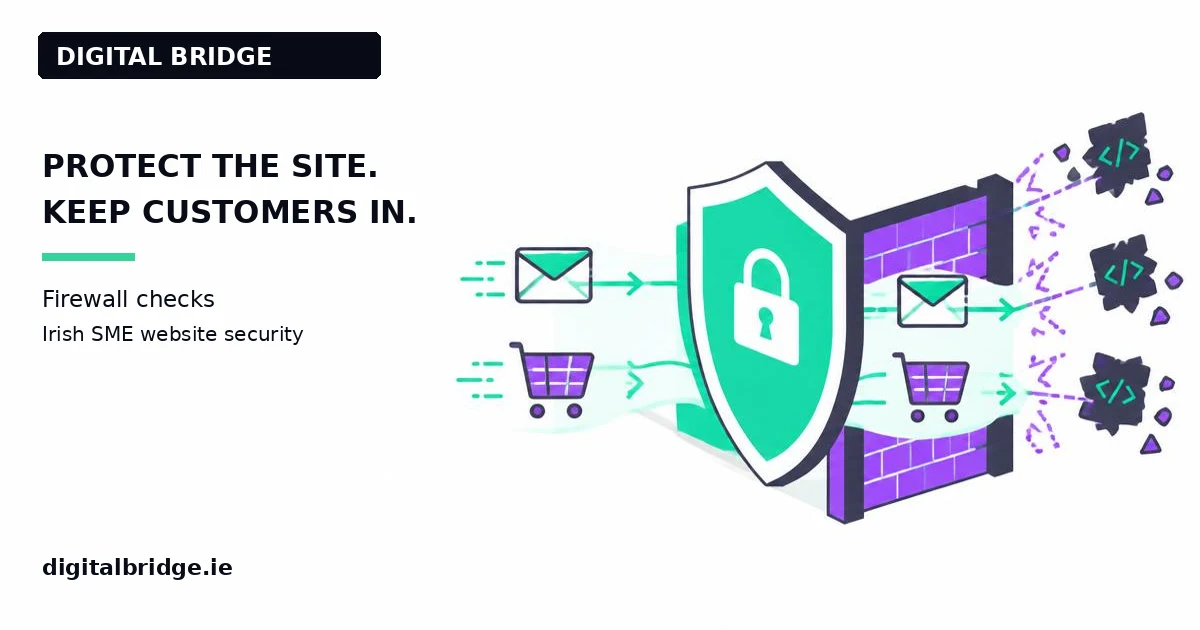
A website firewall should reduce unwanted requests without unnecessarily blocking customers. Irish SMEs should test enquiry, booking and payment journeys after changing protective rules and review the actual event records before adding exceptions. Digital Bridge in Gorey explains how to investigate carefully rather than turning protections off or blocking entire audiences by guesswork.
Written by Joey Bray, Founder & Lead Strategist, Digital Bridge. Author profile. Last updated: 8 November 2026.
Why might a genuine visitor receive a challenge?
Website-edge services assess requests using signals that are not perfect. A legitimate visitor or integration can sometimes match a protective rule. A browser challenge may also be difficult for a particular customer to complete. That is a reason to investigate, not proof that all challenges are wrong.
More info
Ask what the visitor actually experienced: the page, approximate time, visible error and intended task. Do not request passwords or payment-card details. Match that account to authorised security events where possible and keep personal information out of public screenshots.
Cloudflare's WAF documentation explains protective rules and settings. Provider features vary by plan and configuration. Avoid assuming that a rule described online is available or enabled on your own website.
Which customer journeys should you test?
Prioritise the journeys that generate or fulfil business: contact forms, booking, account access and checkout. Also check staff publishing and genuine integrations that call the website. A rule that leaves the homepage working can still block a form request or payment callback.
More info
Use controlled test data and an agreed test environment for payments. Check desktop and mobile browsers, and consider assistive-technology use. Record both success and failure paths rather than treating one successful click as complete validation.
Cloudflare notes that Bot Fight Mode can affect some API or mobile-app traffic. The relevant lesson is to understand the mode's behaviour before enabling it; not every product supports the same exception mechanisms.
How do you review the rule that caused a block?
Find the relevant event and identify the matching rule and action. A developer should compare it with the intended protection. Was it aimed at a sensitive endpoint, a known attack pattern or a broad traffic group? Change only what the evidence justifies.
More info
A blanket country block can exclude genuine customers, travelling staff or services routed through another region. It can also fail to identify attackers using different infrastructure. A geographical rule is a business and risk decision, not a universal shortcut to security.
Document the reason for a change, the affected journey and how it will be reviewed. Preserve an appropriate rollback path. Do not expose internal rule identifiers or detailed protective configuration in customer-facing copy.
When is a narrow exception appropriate?
An exception needs a clearly understood purpose and scope. For example, a verified service endpoint may need specific treatment. Ask whether the platform allows that exception and how it is authenticated; do not trust a request merely because its browser label says it is Google or another familiar service.
More info
Avoid disabling protection across the whole website to solve one unclear failure. If the exact control cannot support the required workflow, choose an appropriate alternative with the developer. A temporary exception should have an owner and review date.
Consider a fictional booking site whose confirmation callback is challenged. The developer identifies the legitimate integration and evaluates an appropriately scoped solution. This is an illustrative workflow, not a claim that a particular client has experienced or solved it.
Does a firewall replace application security?
No. A WAF can help with some request patterns but does not establish correct permissions in your application. A customer account that can read another customer's record is an application problem. Updates, private-data access and account recovery remain separate requirements.
More info
A CDN proxy also does not automatically make the origin server unreachable. Other records or exposed services can reveal or reach it. Origin restrictions must be assessed with the hosting setup, without claiming that a hidden-looking IP makes direct attacks impossible.
What should a sensible review deliver?
Expect an explained finding, agreed changes and tests of the relevant customer journeys. Discuss monitoring and incident-response responsibility separately; continuous monitoring is not a promise that every problem is automatically fixed.
More info
Digital Bridge's website work includes Printhouse's custom web-to-print platform, a genuine application project rather than proof of security certification. From Gorey, Co. Wexford, the agency can scope website configuration and journey checks, with specialist assessment considered for risks beyond that work.
What is the next step for your website?
Get an instant estimate or discuss a scoped website security review. Call 085 224 1848 or email Digital Bridge. Scope and responsibilities are agreed before work starts. For an example of our development work, see the published portfolio.
Read our website security service, Irish SME security overview, or professional website services.
Frequently asked questions
Can a firewall block a genuine enquiry?
Yes. A protective rule can affect a legitimate request, so test form submission and investigate events before changing settings.
Should I turn off protection if checkout fails?
Do not disable everything by default. Identify the matching control and agree a narrow, tested solution with your developer.
Does Cloudflare hide the origin completely?
Not necessarily. A proxy alone does not prove the origin cannot be found or reached; assess records, services and origin access controls.
Everything we do, in one place
Pick the service that fits. The same small Irish team does all the work.
Related pages and sources
Explore more from Digital Bridge
Sources and further reading
Joey Bray
Founder & Lead Strategist
Website and business-platform development for Irish businesses
Joey Bray leads Digital Bridge from Gorey, Co. Wexford. Published work includes Printhouse's custom web-to-print platform; no security certification is claimed.
Connect with us →Keep reading