Website Security
Security Headers: Small Settings Worth Checking
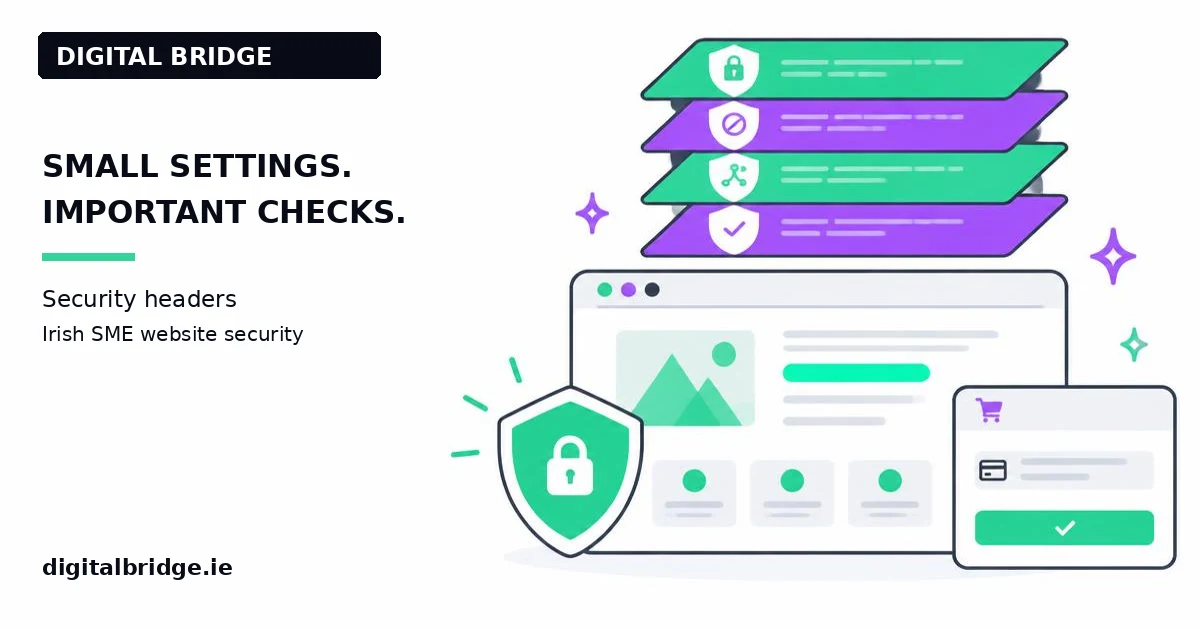
Security headers tell a browser how to handle parts of your website. They can help reduce specific risks, but they do not repair vulnerable application code or establish that a site is safe. Digital Bridge in Gorey explains what Irish SMEs should ask a developer to check and test before changing these settings.
Written by Joey Bray, Founder & Lead Strategist, Digital Bridge. Author profile. Last updated: 8 November 2026.
What is a security header in everyday language?
When your browser requests a page, the server returns the page and extra instructions. Some of those instructions influence whether content can be embedded, which scripts can load or how information is shared with another site. They are usually invisible to the visitor.
More info
The OWASP HTTP Headers Cheat Sheet explains useful response headers and their limitations. A checklist can identify settings worth investigating, but a score is not a complete assessment of the website or its customer-data handling.
Ask your developer which headers the site currently sends and which risks a proposed change addresses. Avoid copying a block of settings from another website without checking your own forms, payments, embedded media and business integrations.
What can a content security policy do?
A Content Security Policy, often shortened to CSP, controls permitted content sources and certain browser behaviours. A carefully designed policy can reduce the impact of some injection attacks. It needs to match the website's actual scripts, styles and external services.
More info
A policy that is too broad may offer little benefit. A policy that is too strict can stop checkout, analytics or an accessibility tool from working. The OWASP CSP guidance describes implementation options, including report-only testing.
Report-only mode can help a developer observe what a proposed policy would block before enforcement. Reports may contain information about visited pages, so their handling and retention need consideration too. Do not turn them into a public troubleshooting feed.
How do headers help with framing and content types?
Framing controls can limit whether another page embeds your site. That can help with clickjacking risks, where a visitor is misled into interacting with a concealed interface. The exact policy depends on whether your business intentionally embeds pages in a trusted service.
More info
Content-type handling is another check. The browser should receive the correct content type, and a developer can consider settings that prevent inappropriate guessing. These controls belong alongside correct server behaviour, not instead of it.
Avoid assuming every old security header is useful. OWASP cautions about obsolete approaches, including legacy browser XSS filters. Ask for a maintained explanation rather than a longer list simply to improve a scanner score.
What about HTTPS and HSTS?
HTTPS protects traffic in transit when correctly configured. HSTS tells compatible browsers to use HTTPS for the covered host after receiving the policy. It is not a web application firewall and does not prevent an authorised user from accessing data they should not have.
More info
Before enforcing HSTS, check HTTPS works consistently and understand the impact on subdomains. A long policy or preload choice can be difficult to reverse quickly. Your developer should explain these implications and test the relevant hostnames rather than applying the strongest-looking value by default.
How should you test without disrupting customers?
Use a staging environment where possible and record the current configuration. Test important journeys: opening the site, submitting an enquiry, signing in, booking and completing a controlled payment test. Review mobile and assistive-technology behaviour where relevant.
More info
After deployment, check the actual responses from the public site, including pages served through a CDN. Different page types can receive different headers. Confirm a rollback process and review whether an external provider has changed its requirements.
For a fictional appointment business, a strict script policy might block an embedded booking service. A developer identifies that dependency in testing and agrees an appropriately narrow policy. This is an illustrative decision, not a client case study.
Where does Digital Bridge's review fit?
Digital Bridge develops websites and platforms from Gorey, Co. Wexford, including Printhouse's custom web-to-print platform. A header review is a limited configuration task within website work, not an independent penetration test or guarantee against compromise.
More info
Agree the pages, integrations, tests and recovery steps in writing. If you require assurance for a regulated or sensitive application, specify that separately. The useful outcome is an explained, tested configuration—not a claim that a scanner score means your business is protected from every attack.
What is the next step for your website?
Get an instant estimate or discuss a scoped website security review. Call 085 224 1848 or email Digital Bridge. Scope and responsibilities are agreed before work starts. For an example of our development work, see the published portfolio.
Read our website security service, Irish SME security overview, or professional website services.
Frequently asked questions
Does a high security-header score prove a website is safe?
No. It measures a limited set of response settings, not every application risk, access rule or operational process.
Can a content security policy break checkout?
Yes. A policy can block scripts or connections a checkout needs, so test the actual payment journey before enforcement.
Should every subdomain use the same HSTS settings?
Assess the real HTTPS configuration and dependencies first. Policies covering subdomains require particular care.
Everything we do, in one place
Pick the service that fits. The same small Irish team does all the work.
Related pages and sources
Explore more from Digital Bridge
Sources and further reading
Joey Bray
Founder & Lead Strategist
Website and business-platform development for Irish businesses
Joey Bray leads Digital Bridge from Gorey, Co. Wexford. Published work includes Printhouse's custom web-to-print platform; no security certification is claimed.
Connect with us →Keep reading