Hospital admin teams, anywhere in Ireland
AI for Hospitals: Less Paperwork, People Still in Charge
Hospital admin teams spend their days on enquiries, letters and forms that follow the same few patterns. AI can answer the public's routine questions, sort documents to the right department and answer staff questions from approved policies, while every clinical decision stays with clinicians.
- Admin work only, never clinical
- Built with your data protection officer
- A fixed written quote first
| Fact | Detail |
|---|---|
| Built for | Private hospitals, hospices and larger health services' admin teams |
| What it handles | Public enquiries, document sorting and staff policy questions |
| What it never does | Diagnose, triage, prioritise patients or write clinical notes |
| How pricing works | A fixed written quote after the AI consultancy visit, whose fee comes off the build |
| What changes the price | How many admin jobs it takes on, which systems it connects to, and how many departments use it |
| Meetings | In person in Wexford and Wicklow; by phone or video call everywhere else |
You deal with the people who build it, from the first call to the day your team takes it over.
What clients say
Digital bridge provided a very efficient and professional service to me. Both Amy and Joey the owners are particularly friendly and compassionate people. They were always ready to listen and answer any questions I had about the development of my new psychotherapy website. I truly appreciate their patience across my interactions with them. They were always on hand to make changes when asked. I am so delighted with my new website. I have had great feedback from people accessing my site as well. Many thanks guys and best of luck with the continuing growth of your great service.
- Recent work
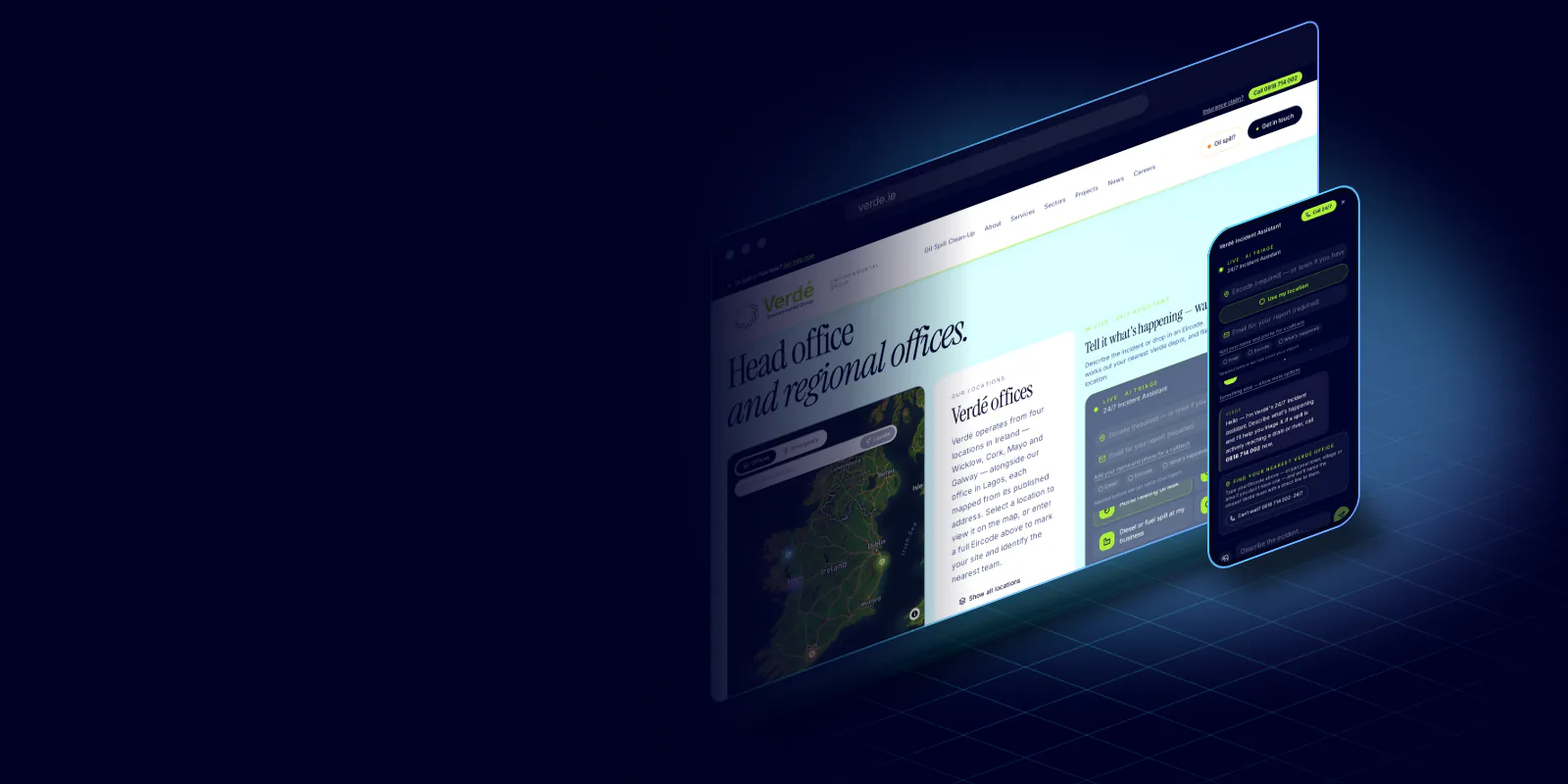
- Verdé Environmental GroupA 24/7 AI assistant that sorts reports, with staff in charge.
This is a fit if
- Admin teams answer the same public questions about visiting, parking, records and departments every day.
- Letters and forms arrive in one inbox and are sorted by hand before anyone can act.
This is not a fit if
- You need AI that reads symptoms, scans or results, or helps decide treatment.
- You want a tool live before your data protection officer and IT team have approved it.
More on who this suits
Also a fit if
- Staff ask the same policy questions and wait for an answer from a busy manager.
Also not a fit if
- You need a supplier for a hospital-wide clinical system.
Large tender or clinical project? We are the wrong fit, and we will say so on the first call: 085 224 1848.
About this page
This page is for hospital and health service admin teams. We build non-clinical tools only. Digital Bridge is the web and AI agency at Unit 8, Enterprise Centre, Gorey Business Park, Gorey, not DigitalBridge Group, a US investment firm. We meet in person in Wexford and Wicklow and by phone or video call everywhere else.
Which hospital admin jobs suit AI?
The ones that follow a pattern and end with a person. Public enquiries about visiting, parking, records requests and departments; incoming letters and forms that need sorting to the right queue; and staff questions whose answers sit in approved policies.
Data behind this graphic
| Area | What AI does | Who decides |
|---|---|---|
| Public enquiries | Answers from approved information | Your admin team |
| Admin documents | Sorts each one to the right queue | Department staff |
| Staff questions | Answers from approved policies | Your managers |
| Clinical decisions | Nothing: never automated | Clinicians |
More info
What a hospital admin build can cover:
- A public enquiry assistant on your website, answering only from information your communications team approves.
- Incoming letters and forms sorted to the right department queue, each with a short summary for the admin team.
- A staff assistant that answers HR and admin policy questions from your approved documents, and shows where each answer came from.
- A record of every automated step, so managers can see what the AI did and switch any part off.
Every one of these ends with a person. Nothing clinical passes through them.
What do HIQA and the DPC expect before AI goes in?
Accountability and a written risk check. HIQA's national AI guidance, published on 29 July 2026, is for every service providing health and social care in Ireland.
More info
The Data Protection Commission says an impact assessment is mandatory for new high-risk processing.
HIQA built its guidance around accountability, a human rights-based approach, safety and wellbeing, and responsiveness (HIQA, 2026). The DPC gives a general hospital keeping patients' medical records as its example of sensitive data, and says an assessment is particularly relevant when a new technology is introduced (Data Protection Commission, 2026). We write both into the plan with your data protection officer before any data moves.
How does the EU AI Act affect hospital admin tools?
Admin assistants must say they are AI. The Act's transparency rules took effect in August 2026, and the European Commission says people should be made aware when they are interacting with a machine.
More info
Clinical and other high-risk uses carry heavier rules, on later dates.
The Commission's AI Act page sets later dates for high-risk systems: rules for high-risk uses in certain sensitive areas apply from 2 December 2027, and for high-risk systems built into regulated products the transition runs until 2 August 2028 (European Commission, 2026). Our tools stay on the admin side of that line, which is why we never take on clinical work.
How do the ways to take admin work off hospital desks compare?
A large agency or systems integrator suits a hospital-wide programme. Off-the-shelf software suits one standard job.
| Option | Best for | Fits your own wording and queues | Who runs it day to day |
|---|---|---|---|
| Digital Bridge | One or two admin jobs, built around your department | Yes | The department that uses it |
| Large agency or systems integrator | Hospital-wide programmes and tenders | Yes, at programme scale | A project team |
| Off-the-shelf software | One standard job, the same as other hospitals | Partly | The software's settings |
| Your own staff, by hand | Low volumes | Yes | Your admin team, every day |
More info
A focused build suits one or two admin jobs your own staff know well, with the department in charge.
Frequently asked questions about AI for hospital admin teams
Plain answers to what hospital managers and data protection officers ask us.
Do you build clinical AI?
No. We do not build tools that read symptoms, scans or results, prioritise patients or write clinical notes. Our work is on the admin side, with a person at the end of every step.
Can the public assistant give medical advice?
No. It answers practical questions about visiting, parking, records requests and departments from information your hospital approves. Any medical question gets a set reply pointing to the right phone line, or 112 or 999 in an emergency.
How does document sorting work?
Incoming letters and forms are read and placed in the right department's queue with a short summary. Staff open, check and act on each one; the AI never files anything into a patient record on its own.
Who signs off before it goes live?
Your data protection officer, your IT team and a named owner in the department that uses it. We provide the written plan, the impact assessment notes and a record of every automated step.
Will it reduce admin posts?
That is not what we build for. It takes repeat sorting and answering off desks so admin staff spend more time on the work that needs a person. Your team checks its work and can switch it off at any time.
How is the price set?
One fixed price in writing after the AI consultancy visit, with the visit fee taken off the build. The number of admin jobs, the systems it connects to and the departments using it move the price.
Terms used on this page
Plain meanings for the guidance, data and AI words on this page.
See all 4 terms
- Non-clinical AI
- Software that helps with admin work and never with diagnosis or treatment.
- Department queue
- The list of documents waiting for one team to read and act on.
- DPIA
- A data protection impact assessment: a written check of the risks before new processing starts.
- High-risk AI system
- An AI Act category with stricter rules, applying on later dates than the transparency rules.
Sources and further reading
The official pages behind the facts on this page.
See all 3 sources
- HIQA publishes first National Guidance on Responsible and Safe Use of AI in Health and Social Care Services, HIQA, 2026The four principles the national AI guidance for health services is built around.
- Data Protection Impact Assessments, Data Protection Commission, 2026Impact assessments, with a hospital's medical records as the example of sensitive data.
- AI Act, European Commission, 2026Transparency rules, and the later dates for high-risk systems.
What happens next when you ask about AI for hospital admin?
Send the form or ring. We reply the same working day and arrange the AI consultancy visit with your admin lead and data protection officer. A fixed written quote follows, with the visit fee taken off the build.
What we ask for, and the terms
- What we ask for
- your name, business name, phone, email, the jobs that take up most of your team's time
- Reply time
- The same working day, Monday to Friday
- Site visit
- In person in Wexford and Wicklow, at your premises or at Unit 8, Enterprise Centre, Gorey Business Park; by phone or video call everywhere else.
- Deposit and billing
- The consultancy visit is paid before it takes place and comes off the build price; the build is 50% to start, 50% at launch.
- How the price is confirmed
- A fixed written quote after the visit: the price, what the AI will and will not do, who checks its work, and the dates.
- Changing your mind
- Before work starts you can walk away at no cost; after that, the terms in your quote apply.
Get a fixed price for AI in your admin team
Tell us which enquiries, documents or questions fill your team's day; we reply the same working day and quote in writing after the consultancy visit. Or ring 085 224 1848.